


Click the tartan to view its entry in The Scottish Registers of Tartans which includes registration details, restrictions, and registrant information.
Unregistered tartans may link to one of the web's online design environments for similar information.
For any questions about reproduction of designs or weaving of these tartans, please contact the registrant directly or via this website.
Heathering Wednesdays
"Farewell to the heather and flowery broom,
Farewell to the mountains so lofty and brown;
Farewell to the bonnie blue hills and clear streams,
Farewell to the land of my fathers and dreams."
~ My Heart's in the Highlands, Robert Burns, 1789
Winter is deeply entrenched in much of the world, but early heathers are already budding and even blooming in some areas, with promises of spring and ancestral reminders.
Although Heather is a plant and flower closely associated with Scotland, some heathers are non-native cousins which thrive in the mountainous areas of central, eastern and southern Europe, where it grows in coniferous woodlands or on stony slopes.
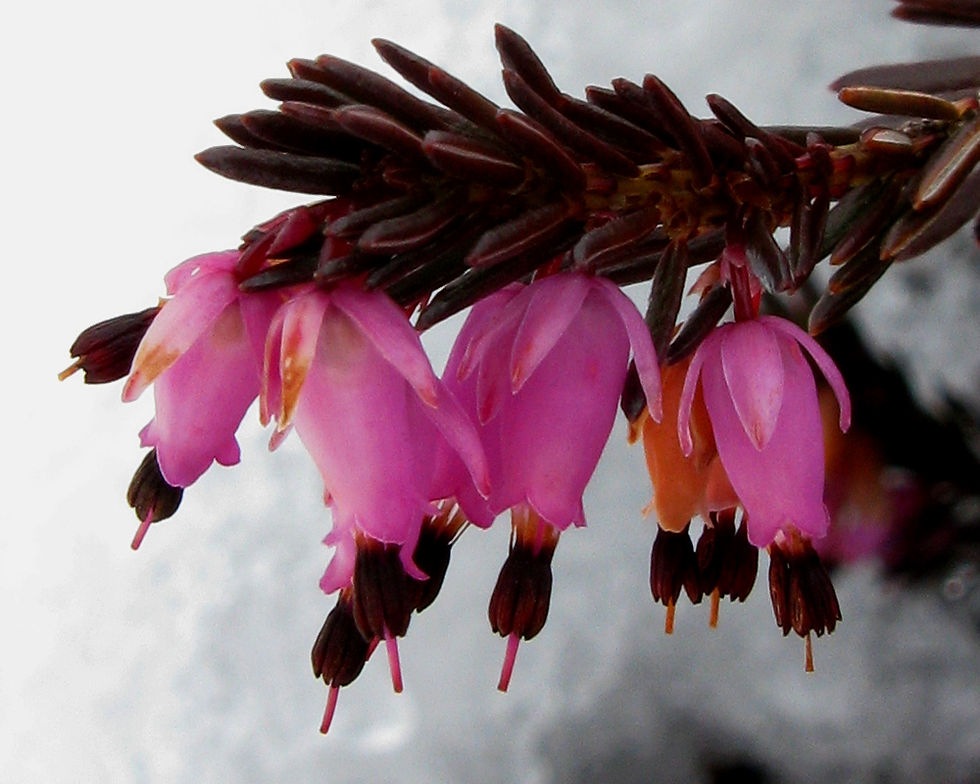
Erica carnea, the winter heath, also known as winter-flowering heather, spring heath or alpine heath, is a species of flowering plant in the family Ericaceae which brings early cheer to the chilliest months. This hardy European native can start blooming while still covered in snow, offering slender bell-shaped flowers in shades of deep red, pink and even white right when most plants are still asleep.
Erica carnea was being cultivated in the United Kingdom as early as 1763. It is very widely grown as an ornamental plant for its winter flowering. Over 100 cultivars have been selected for variation in flower and leaf colour. Some of the favourite cultivars for a winter garden include:
Erica carnea ‘Adrienne Duncan’ — a seedling found at Blairgowrie, Perthshire (Scotland), and named for Lady Duncan of Jordanstoun.
Erica carnea ‘Myretoun Ruby’ — raised from seed at Myretoun, Menstrie, Clackmannonshire (Scotland) (also often described as named for “Myretoun” in Scotland).
Erica carnea f. alba ‘Springwood White’ — originally named ‘Springwood’ after Mrs Walker’s house in Stirling, Scotland (with “White” added later).
There are lovely heathers for most all zones and regions should you want to add some to your own garden! And of course, you can sport some heather at any time of the year anywhere via one of the beautiful tartan tributes inspired by the delicate yet hardy "fraoch". 🖤 💜 ❤️ 🤍.

Heather is often imagined as a single plant covering the Scottish hills, but in reality it is a whole family of small evergreen shrubs adapted to cool climates across the globe. What unites them is not appearance alone but ecology — they evolved for nutrient-poor, acidic soils where trees struggle and grasses grow thin. Wherever the land is too exposed, too sandy, too peaty, too windswept, or too cold for forest, heather tends to take over.
In the British Isles the dominant wild species is Calluna vulgaris, sometimes called ling heather. It forms immense moorlands that colour entire mountainsides purple in late summer. These landscapes are not random wildflower fields but ancient ecological communities shaped by grazing, burning, and weather. The plants grow slowly and can live for decades, forming woody bases beneath their soft flowering tips. Historically they provided thatch, bedding, dye, fuel, and even ale flavouring long before hops became common.
Across mainland Europe, heathlands stretch from Norway to Spain, but the species composition changes with climate. In colder northern regions, heather mixes with lichens and dwarf birch in tundra-like terrain. Farther south in sandy coastal plains, it grows beside gorse and pine in dry, sun-bleached barrens. These ecosystems depend on disturbance — wind, fire, or grazing — because without it, trees eventually shade out the low shrubs. Many European heathlands today exist because centuries of human land use unintentionally preserved them.
Winter-flowering heathers largely come from mountains of central and southern Europe. Species such as Erica carnea evolved under snowpack conditions, blooming immediately when thaw arrives. Others like Erica × darleyensis are natural hybrids that thrive in milder maritime climates. These plants turned heather into a garden staple because they extend flowering into the coldest months when little else blooms.
Southern Africa holds the greatest diversity of all. In the Cape Floristic Region, hundreds of Erica species grow in the fynbos biome — a shrubland comparable to Mediterranean chaparral but even more specialized. Some species resemble miniature pine trees, others trailing moss, and some bear long tubular flowers designed specifically for sunbirds rather than insects. Unlike northern heathers that tolerate cold, many of these require periodic fire to regenerate, releasing seeds only after the heat passes.
Australia also has plants commonly called heath, though many belong to related families rather than true Erica. Vast heathlands grow on nutrient-poor sands along the southern coasts, filled with small flowering shrubs adapted to drought and wildfire. They occupy a similar ecological niche: landscapes too harsh for forest but rich in specialized biodiversity.
For more on winter heathers for a garden, click the picture of Erica carnea.