



Misc
Click THE TARTAN FOR REGISTRY INFORMATION IF AVAILABLE
CLICK THE PICTURE FOR MORE INTERESTNG INFORMATION!


Rabbie's Dram
Brian Wilton
Burns Night Preparation
Jan 22
"‘Twill make a man forget his woe;
‘Twill heighten all his joy;
‘Twill make the widow’s heart to sing,
Tho’ the tear were in her eye.’"
~ Scotch Drink, Robert Burns, 1786
Preparing to attend or host a Burns Supper in the near future? Here's a whisky-coloured tartan to inspire, dedicated to the man himself, who certainly enjoyed a dram or two!
As an overall nod to whisky’s legacy, this warmly hued Rabbie’s Dram tartan incorporates amber for the whisky, green for the bottles, and dark brown and black to represent whisky barrels with their iron hoops. The amber and green also symbolize the barley’s growth cycle.
Legend has it that Robert Burns first encountered whisky at the age of 22 while working as an apprentice flax-dresser in Irvine, Ayrshire, before turning to farming.
Whisky flows through his poetry, often as a subject or metaphor for freedom and rebellion. Occasionally, he even named specific distilleries, though not always with high praise.
In The Jolly Beggars (1785), inspired by a visit to Poosie Nansie’s Tavern in Mauchline, Burns mentions “...dear Kilbagie.” Located in Kincardine near the River Forth, Kilbagie’s whisky was distilled quickly in shallow stills, producing a spirit notorious for its harshness. Burns himself declared it “the most rascally liquor” consumed only by “the most rascally part of the inhabitants.”
Though Kilbagie’s whisky is no longer made, there are many modern more mellow tributes which honor the Ploughman Poet and his works including:
* Robert Burns Single Malt (from the Isle of Arran)
* the rare 1970s Robbie Burns Blended Scotch (R.H. Thomson & Co)
* Sweet Afton
* Tam O’Shanter
* Cutty Sark
* Timorous Beastie, a Highland single malt blend described as sweet with notes of heather honey.
So, choose your celebration whisky boldly, to share with or toast the rascally inhabitants or timorous beasties in your own circle, and raise a toast to the legacy of Burns and the power of poetry! Slàinte! 🤎 💛 ❤️ 💚 🖤 🥃 🐁 🏴


Auld Lang Syne
Burns Night
Jan 25
"Should auld acquaintance be forgot, And never brought to mind? Should auld acquaintance be forgot, And auld lang syne." ~ Robert Burns, 1788
In 1788, Robert Burns sent the poem 'Auld Lang Syne' to the Scots Musical Museum, indicating that it was an ancient song but that he'd been the first to record it on paper. The phrase 'auld lang syne' roughly translates as 'for old times' sake', and the song is known the world over for its sentiments of preserving and remembering old friendships and fellowship. It is a traditional ending to many Burns Suppers.


Burns Check
Burns Night
Jan 25
"🎶 Is there for honest Poverty
That hings his head, an’ a’ that;
The coward-slave, we pass him by,
We dare be poor for a’ that!
For a’ that, an’ a’ that.
Our toils obscure an’ a’ that,
The rank is but the guinea’s stamp,
The Man’s the gowd for a’ that.
What though on hamely fare we dine,
Wear hoddin grey, an’ a that;
Gie fools their silks, and knaves their wine;
A Man’s a Man for a’ that:
For a’ that, and a’ that,
Their tinsel show, an’ a’ that;
The honest man, tho’ e’er sae poor,
Is king o’ men for a’ that.
Ye see yon birkie ca’d a lord,
Wha struts, an’ stares, an’ a’ that,
Tho’ hundreds worship at his word,
He’s but a coof for a’ that.
For a’ that, an’ a’ that,
His ribband, star, an’ a’ that,
The man o’ independent mind,
He looks an’ laughs at a’ that.
A Prince can mak a belted knight,
A marquis, duke, an’ a’ that!
But an honest man’s aboon his might –
Guid faith, he mauna fa’ that!
For a’ that, an’ a’ that,
Their dignities, an’ a’ that,
The pith o’ Sense an’ pride o’ Worth
Are higher rank than a’ that.
Then let us pray that come it may,
As come it will for a’ that,
That Sense and Worth, o’er a’ the earth
Shall bear the gree an’ a’ that.
For a’ that, an’ a’ that,
It’s comin yet for a’ that,
That Man to Man the warld o’er
Shall brithers be for a’ that.
~ "A Man's a Man for A' That", Robert Burns, 1795
Happy Burns Night and Happy Birthday , Rabbie! One of the first Robert Burns tribute tartans, this Border check was created in 1959 for the bicentennial of the poet's birth and accepted by the Burns Federation in the same year! It is a coloured variation of a Border tartan weave (also sometimes referred to as Northumbrian tartan, Shepherds' Plaid, Border Drab, or Border check) and is historically associated with the Anglo-Scottish Border, including the Scottish Borders and Northumbria. In the portrait, Burns is shown wearing the maud (plaid) made popular by fashionable Border Scots such as Robert Burns, Sir Walter Scott, James Hogg, and Henry Scott Riddell. This tartan was created when Baron Marchand of Messrs George Harrison & Co. of Edinburgh was approached by a friend from 'The Scotsman' newspaper with the suggestion that he design a Robert Burns tartan. The first idea had been to base it on the Campbell - a clan with which the Burns family were connected - but after much discussion it was decided to model it on the Shepherd's Check and to introduce an overcheck referencing Rabbie's reference to the 'the hodden grey and a' that' and to include a little flavour of green fields. Sláinte to all celebrating today! ✍️ 🎂 🏴 🥃


Rabbie Burns
Burns Night
Jan 25
"My father was a farmer upon the Carrick border O And carefully he bred me in decency and order O He bade me act a manly part, though I had ne'er a farthing O For without an honest manly heart, no man was worth regarding O Then out into the world my course I did determine. O Tho' to be rich was not my wish, yet to be great was charming. O My talents they were not the worst; nor yet my education: O Resolv'd was I at least to try to mend my situation. O" ~ My Father was a Farmer, Robert Burns, 1784
Robert Burns, Scotland's national poet, was born the 25th of January, 1759, two miles south of Ayr, in Alloway, the eldest of the seven children of William Burnes, a self-educated tenant farmer from Dunnottar in the Mearns, and Agnes Broun, the daughter of a Kirkoswald tenant farmer. Though celebrated in his lifetime, Burns was never able to sustain a stable financial situation. Hard work and hard living destroyed his health, and he died in poverty at the age of thirty-seven, haunted by the shadow of debtors' prison. Even on his death-bed, he got a letter in which he was threatened with imprisonment for a debt of seven pounds. After his death, on the 21st of July, 1796 in Dumfries, his widow and children were left impoverished. But his funeral was attended by a crowd of a thousand, and enough money was raised by subscription to provide his widow with sustenance for the rest of her life and to give all his children an education. His exceptional talents and his ability to empathize with and portray the plight of common man and the human condition, continue to make for a personal connection for many to this very day. ✍️ 🏴


Red Red Rose
Burns Night & Chinese New Year (Jan 25, 2020)
Jan 25
Gung Haggis Fat Choy!
This tartan was designed in celebration of Chinese New Year and Burns Night, simultaneously occurring on the 25th of January 2020. Chinese New Year is the most important and widely celebrated festival in the Chinese calendar, whilst Robert Burns Night commemorates Scotland’s renowned poet. Festivities take place across the globe to mark both occasions. The Burns Check, named after Scotland’s National Bard, is woven in a new red colourway - a symbolic colour representing joy and happiness in Chinese culture. The Red Red Rose tartan brings both together to celebrate the historical moment when these two events coincide, which will not occur again until the year 2096.


Robert Burns Legacy
Lochcharron of Scotland
Burns Night
Jan 25
"Ev'n then a wish (I mind its power)
A wish, that to my latest hour
Shall strongly heave my breast;
That I for poor auld Scotland's sake
Some useful plan, or book could make,
Or sing a sang at least."
~ Extract from The Epistle to Mrs. Scott of Wauchope, Robert Burns, 1787
Robert Burns (1759–1796) was Scotland’s national poet, celebrated for capturing everyday life, love, politics, and the dignity of ordinary people in verse that blended Scots dialect with lyrical English. Raised on a small Ayrshire farm, Burns drew deeply from rural traditions and folk culture, producing enduring poems and songs such as “Auld Lang Syne,” “Tam o’ Shanter,” and “To a Mouse.” His work helped preserve Scottish language and song, and his influence endures worldwide—especially each January, when Burns Suppers honor his legacy with poetry, music, and conviviality on or around his Jan 25 birthday!
Major statues of Robert Burns are scattered across the world, reflecting both Scotland’s pride in its national poet and the global reach of the Scottish diaspora. In Scotland, prominent monuments stand in Edinburgh, Glasgow, Dumfries, and Alloway, often portraying Burns as the thoughtful, democratic bard of the people. Beyond Scotland, Burns is memorialized in cities shaped by Scottish emigration: statues in New York City, Montreal, and Toronto anchor annual Burns Night traditions, while monuments in Dunedin and Sydney underscore his symbolic role in civic and cultural life. On the U.S. West Coast, a notable Burns memorial in San Francisco, located in Golden Gate Park, reflects the poet’s enduring resonance among California’s historic Scottish community.
The statue of Robert Burns in Dunedin is one of four full-length castings of the celebrated design by Sir John Steell, whose original monument was erected in Edinburgh. Companion statues from the same sculptural model were later installed in Dumfries, where Burns spent his final years, and in New York City, reflecting the poet’s importance to the Scottish diaspora abroad. Unveiled in Dunedin in 1887, the statue speaks to the city’s strong Scottish foundations and its founders’ desire to carry literary, moral, and civic ideals into a new land. Standing near the Octagon, it has long served as a focal point for public gatherings and Burns Night commemorations, symbolizing the enduring cultural link between Scotland and New Zealand.
Burns' ability to empathize with and illustrate the human condition have inspired artists, writers, poets, and musicians throughout the world. This tartan is just one of many created to honour and preserve his contributions. 💙 💚 🖤 ❤️ ✍️ 🎼 🏴 🥃


Robert Burns World Federation
Ewan MacDonald and the Burns World Federation
Burns Night
Jan 25
"🎶 Is there for honest Poverty
That hings his head, an’ a’ that;
The coward-slave, we pass him by,
We dare be poor for a’ that!
For a’ that, an’ a’ that.
Our toils obscure an’ a’ that,
The rank is but the guinea’s stamp,
The Man’s the gowd for a’ that.
What though on hamely fare we dine,
Wear hoddin grey, an’ a that;
Gie fools their silks, and knaves their wine;
A Man’s a Man for a’ that:
For a’ that, and a’ that,
Their tinsel show, an’ a’ that;
The honest man, tho’ e’er sae poor,
Is king o’ men for a’ that.
Ye see yon birkie ca’d a lord,
Wha struts, an’ stares, an’ a’ that,
Tho’ hundreds worship at his word,
He’s but a coof for a’ that.
For a’ that, an’ a’ that,
His ribband, star, an’ a’ that,
The man o’ independent mind,
He looks an’ laughs at a’ that.
A Prince can mak a belted knight,
A marquis, duke, an’ a’ that!
But an honest man’s aboon his might –
Guid faith, he mauna fa’ that!
For a’ that, an’ a’ that,
Their dignities, an’ a’ that,
The pith o’ Sense an’ pride o’ Worth
Are higher rank than a’ that.
Then let us pray that come it may,
As come it will for a’ that,
That Sense and Worth, o’er a’ the earth
Shall bear the gree an’ a’ that.
For a’ that, an’ a’ that,
It’s comin yet for a’ that,
That Man to Man the warld o’er
Shall brithers be for a’ that.
~ "A Man's a Man for A' That", Robert Burns, 1795
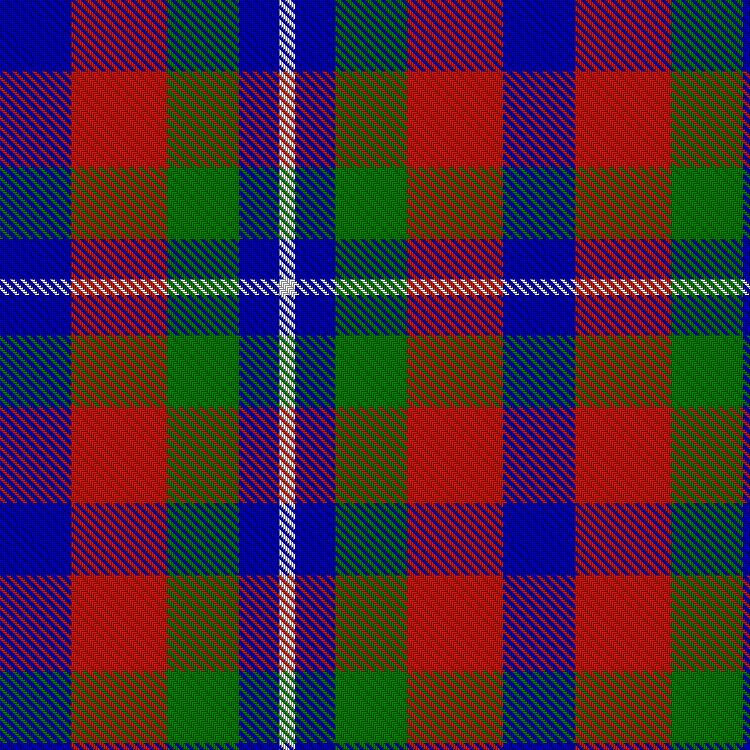
Raise a glass and toast to the immortal memory of Scotland’s beloved bard, Robert Burns! On this Burns Night, we celebrate his legacy with a tartan that embodies the essence of his life and works, created with meaning and reverence for the Robert Burns World Federation (RBWF). Each color tells a story, connecting us to the poet’s enduring spirit and the land he so eloquently cherished.
Red symbolizes the blood of humankind, immortalized in Burns' powerful song A Man’s A Man for A’ That, famously sung to open the Scottish Parliament.
Light blue reflects the pale skies under which Burns labored as a farmer, as well as the shimmering lochs and rivers of Scotland.
Yellow represents the gold of the harvest and the chain of office, connecting us to the prosperity and leadership celebrated in his time.
Green honors the natural beauty that inspired so much of Burns' poetry, from lush landscapes to timeless love stories.
Black signifies the ink with which he poured his soul onto the page.
White evokes the blank pages upon which his genius was immortalized.
Let us celebrate with heartfelt gratitude for the poet whose words continue to inspire the world. ❤️ 💙 💛 💚 🤍 🖤 ✍️