


MISC
Click THE TARTAN FOR REGISTRY INFORMATION IF AVAILABLE
CLICK THE PICTURE FOR MORE INTERESTNG INFORMATION!

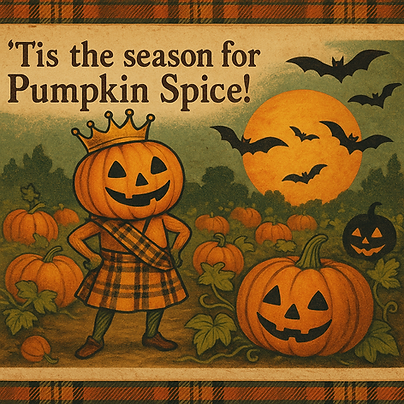
Royal Pumpkin Spice
Curious and Unusual Tartans
Pumpkin Spice Season
Oct 3
"Oh my gourd, Pumpkin Spice Season is back!"
Pumpkin, cinnamon, ginger, nutmeg, allspice ... Love it or hate it, this is the season of all things Pumpkin Spice, including the ubiquitous Pumpkin Spice Latté from a well known coffee franchise!
Considered the Holy Grail of coffee drinks, the Pumpkin Spice Latté craze started in 2003, though this namesake spice combination's spicy origins go back to the 1950's when spice companies released combinations of traditional spices as an easy way to flavour a pumpkin pie or pumpkin bread.
Inspired by the young ladies at the San Jose School of Highland Dancing, who welcome this harbinger of fall with great glee, this tartan is based on a spicy pumpkin-themed version of Royal Stewart with a whimsical nod to the traditional colours and flavours of the harvest and Hallowe'en season, and a hint of the scent of pumpkin pies soon to be baked. Happy Old-Fashioned October! 🧡 💛 🖤 🧡 🎃


Sunset
Carol A.L. Martin
Pumpkin Festival Days
Oct 20
"When the frost is on the punkin and the fodder's in the shock,
O, it sets my hart a-clickin' like the tickin' of a clock,
When the frost is on the punkin and the fodder's in the shock!"
~ James Whitcomb Riley, When the Frost is On the Punkin, 1849 - 1916
October ushers in the first frosts and fiery sunsets, painting the world in glowing shades of red, orange, and gold. Pumpkin patches come alive under these skies—bright oranges against clear blue skies, cheerful, and ready for the Hallowe'en season. In many parts of North America and elsewhere, this is the season of harvest and pumpkin festivals, where communities gather to carve, weigh, and even toss these iconic squashes, smashing records and pumpkins alike!
Pumpkins, native to the New World, have long found their place in autumn folklore and eventually in literature, too. The word pumpkin first appeared in the 17th century reworking of the fairy tale Cinderella, when a humble gourd becomes a glittering carriage at the touch of a fairy godmother’s wand. Earlier versions of Cinderella—like Giambattista Basile’s Italian La Gatta Cenerentola (1634) and the even older Chinese tale Ye Xian (9th century) highlighted the heroine’s transformation through magical animals, fairy helpers, or enchanted trees, not vegetables. It was Charles Perrault’s 1697 French version that first introduced the pumpkin carriage, marking the recent import of these "exotic squashes" from the Americas to Europe.
Artists of the same period shared Perrault’s fascination. In the 17th century, European still-life painters began including pumpkins in their lavish table scenes—symbols of abundance, curiosity, and the faraway lands from which they came.
Through the years, pumpkins have also figured in countless stories—from the mid-century modern Peanuts’ “The Great Pumpkin,” to the shattered gourd hurled by the Headless Horseman in Washington Irving’s The Legend of Sleepy Hollow. There’s also Jack Pumpkinhead in L. Frank Baum’s The Marvelous Land of Oz, and Feathertop, Nathaniel Hawthorne’s enchanted scarecrow with a pumpkin for a head.
And of course, pumpkins became the New World’s lantern of choice, replacing Old World turnips and parsnips as the vegetable of choice to be hollowed and carved into lanterns used to scare away wandering spirits!
And in recent news, the champion pumpkin at the Half Moon Bay in California Pumpkin Festival weighed in at an astounding 2,346 pounds! And this same month, the current world-record pumpkin was grown by a pair of twin brothers from the United Kingdom. That pumpkin weighed in at 2,819 pounds - as much as a full grown rhinoceros!!
Good gourd, indeed! 💙 🧡 🖤 💛 🤍 🎃 🎃 🎃


Nuts and Bolts
Carol A.L. Martin
Nutting Parties & Nutcrack Nights
Oct 22
"The old goodwife’s well-hoarded nuts,
Are round and round divided,
And many lads' and lasses' fates
Are there that night decided:
Some kindle cozily, side by side,
And burn together trimly;
Some start away, with saucy pride,
And jump out over the chimney"
~ Robert Burns, Halloween, English translation, 1786
Inspired by a popular mid-century modern party mix snack food of cereal wheat squares, pretzels, and nuts, this tartan augurs good fortune for the Oracle of Nuts, otherwise known as Nutcrack Night! Besides apples, using nuts in Hallowe'en divination spells was a favourite fortune-telling game at parties for young people in the 19th and 20th centuries. On Nutcrack Nights, after an evening of gathering nuts from obliging trees, as a fun game to add to the general merriment, girls and boys would pair up as theoretical romantic partners and place hazelnuts and chestnuts to roast on the fire, side by side. If a nut hissed and steamed, it indicated a fretful temper in the owner of the nut; if both nuts equally misbehaved it augured strife for the pair. And if one or both popped away, separation was inevitable. But if both burned to ashes tranquilly side by side, a love attachment was forecast, with a long life of undisturbed happiness would be the couple's happy lot. 🎃 💕 🌰 🔥


Green Flash
Carol A.L. Martin
Ghosts & Phantoms Night
Oct 23
“He who has been fortunate enough once to behold it is enabled to see closely into his own heart and to read the thoughts of others.”
~ The Green Ray, Jules Verne, 1882
A vivid imagination and tricks of the eye can stir up visions of green ghosts and phantoms during the Hallowe’en season. Among them are the famous Green Lady spirits from Scottish folklore! Often appearing with a greenish hue or dressed in a green gown, these apparitions are typically harmless and, in some cases, even regarded as protectors of the buildings they haunt. Green Ladies are said to roam the halls of Stirling Castle, Caerphilly Castle (Wales), Crathes Castle, Fyvie Castle, and Skipness Castle. Other greenish specters, like the ignis fatuus—known as will-o'-the-wisp—are natural phenomena caused by glowing swamp gas, or the cool green flicker of fireflies. Then there's the rare "green flash" or "green ray," an optical phenomenon briefly seen at sunset or sunrise, often observed from a low vantage point with a clear view of the horizon, like the open sea. This tartan brilliantly captures that vivid green flash against the deep reds and oranges of a sunset sky! Have you ever seen this elusive green phantom? Legend says that once you've glimpsed the green flash, you’ll never go wrong in matters of the heart! 💚 🧡 ❤️ 💙 🖤 💛 ❇️ 🌇 👻


Dark Grey Wolf
Carol A.L. Martin
Werewolf Night
Oct 24
“Even a man who is pure in heart and says his prayers by night
May become a wolf when the wolfbane blooms
And the autumn moon is bright.”
~ The Wolf Man (1941)
October's full moon of the 17th has already passed, but that is no reason to not take all the necessary precautions. This tartan, with its colors contrasting the dark fur of the wolf and its piercing yellow eyes, was inspired by the designer's real encounter with a Grey Wolf! Grey wolves are found from Alaska and the upper Mackenzie River Valley, south through western Canada (excluding prairie areas) and into the Northwestern United States. Wolves have a long, complex relationship with humans. They were often feared and hunted by pastoral communities for attacking livestock, yet admired in agrarian and hunter-gatherer societies. Their haunting howl and keen intelligence have made them legendary figures in myth and folklore. Many cultures tell stories of "werewolves" - humans cursed to transform into wolves, often under the light of the full moon. Remedies for lycanthropy (werewolfism) varied across regions, ranging from exorcisms and physical exhaustion to using wolfsbane, a toxic herb. However, in Schleswig-Holstein, Germany, it was believed that addressing a werewolf by its Christian name three times could break the curse, while a Danish belief claimed that merely scolding the werewolf could do the trick! Bad werewolf, bad! Howwwwwwwl! 🐺 🌑 🌙 🌓 🌖 🌕


Black Shadow
Shades and Shadows Night
Oct 25
"Thy soul shall find itself alone 'mid dark thoughts of the grey tomb-stone; not one, of all the crowd, to pry into thine hour of secrecy."
- "Spirits of the Dead", Edgar Allan Poe (1809-1849)
In poetry and literature, a "shade" shares the same etymological root as "shadow" and represents the spirit or ghost of a deceased person, often residing in the underworld. A shade is not always seen as an embodied ghost but rather as a psychic echo, reflecting the emotional state of the restless spirit at the moment of death. This tartan evokes a ghostly resonance, with shades of grey upon black, or perhaps black upon grey, suggesting the thin veil between the living world and the shadow realm.
One of Scotland’s most haunted castles is Glamis Castle, nestled in the lowland valley of Strathmore near Forfar, the county town of Angus. From its earliest days, the castle and its surroundings have been the scene of grim deeds and eerie apparitions. In 1034, King Malcolm II was murdered at Glamis, then a Royal Hunting Lodge—an event immortalized in Shakespeare’s "Scottish Play." While the historical King Macbeth had no connection to the castle, Glamis has its own dark legends, with at least nine reported spirits haunting its walls, including:
The Woman without a Tongue
The Grey Lady of Glamis
The Young Servant Boy
The Ghost of Earl Beardie
The Secret Chambers
The Ogilvy Clan
The Monster of Glamis
The ghost of Earl Beardie, a 15th-century figure identified with both Alexander Lyon, 2nd Lord Glamis, and Alexander Lindsay, 4th Earl of Crawford, is perhaps the most infamous. His restless spirit is said to be engaged in an eternal game of cards with the Devil. Known for his cruelty and heavy drinking, Earl Beardie was once warned to stop playing cards on the Sabbath. Enraged, he cursed and swore he would play until doomsday—even with the Devil himself. According to legend, a mysterious stranger soon arrived at the castle and joined the Earl in his fateful game, sealing his soul in exchange for an eternity of gambling. The Earl is still said to wander the castle, appearing beside unsuspecting sleepers before returning to his hidden chamber to continue his endless, infernal game of cards. 🖤 🖤 🖤 🏰 👻 👻 👻 ♠️ ♥️ ♣️ ♦️


Pumpkin Seeds
Carol A.L. Martin
Pumpkin Day
Oct 26
"The old time custom of keeping up Hallowe'en was not forgotten last night by the youngsters of the city. They had their maskings and their merry-makings, and perambulated the streets after dark in a way which was no doubt amusing to themselves. There was a great sacrifice of pumpkins from which to make transparent heads and face, lighted up by the unfailing two inches of tallow candle."
~ The Jack O'lantern (le Feu-Follet), Or the Privateer, James Fenimore Cooper, 1842
Beware, oh ye gourds of orange, yellow, green, and white — your time is nigh! In the Americas, the pumpkin reigns supreme as the Jack-o-Lantern of Hallowe’en, glowing bravely to ward off wandering Samhain spirits (and conveniently providing a bounty of seeds for toasting).
But before New World pumpkins took over colonial porches and fields, the old-world folk of Scotland and Britain relied on more modest vegetables for their spooky lanterns — beets, turnips, and rutabagas (or “swedes”), even the humble potato! Their candle-lit ghostly grins once flickered through foggy nights long before pumpkins arrived to steal the spotlight.
And still today, in the northeastern corners of France near Belgium, Luxembourg, and Germany, children carve sugar beets into ghoulish faces and set candles inside. These eerie creations glow from windowsills on the eve of All Saints’ Day during “Nuit des Betteraves Grimaçantes” or “Rommelbootzen” — The Night of the Grimacing Beets.
Oh my gourd! 🧡 💚 💛 🤎 🎃 🎃 🎃 🕯️


Black Cat
Carol A.L. Martin
Black Cat Night
Oct 27
"A ghost, though invisible, still is like a place your sight can knock on, echoing; but here within this thick black pelt, your strongest gaze will be absorbed and utterly disappear ..."
~ Black Cat, Rainer Maria Rilke (1875-1926)
Meowwwwr! Black cats have long been cloaked in mystery—misunderstood by some, yet cherished by many. Though certain cultures once cast them as omens of misfortune, others have seen them as radiant symbols of luck and protection! This beautiful tartan is a fitting feline tribute to black furred cats everywhere, woven in tones black as night with a barely visible shadow grid and the striking bright streak representing their beautifully golden-green and copper illuminated eyes!
In Japan, a black cat is said to increase a single woman’s number of admirers, while in Germany, one crossing your path from left to right foretells good fortune. And in Scotland, should a sleek black visitor appear at your doorstep unannounced, prosperity is said to be on the way!
British sailors once shared this reverence, welcoming cats aboard their ships not just to chase mice but to guard against danger. Black cats, especially, were considered lucky charms—faithful companions who could ensure a safe return home. One such feline, Tiddles of the Royal Navy, journeyed more than 30,000 miles, delighting his crew and often playing with the capstan’s bell-rope along the way.
Though the Royal Navy banned animals from ships in 1975, the spirit of these seafaring mousers lives on. Black cats still pad the decks of private vessels today.
Of course, some folks still insist black cats are witches’ familiars ... well, witches need pest control too! Meow and hiss! 🖤 💛 💚 🧡 🐈⬛ 🐈⬛ 🐈⬛


Black Magic
Carol A.L. Martin
Witches' Night Out
Oct 28
“By the pricking of my thumbs,
Something wicked this way comes.
Open, locks, Whoever knocks!”
~ MacBeth, William Shakespeare, (c. 1603-1607)
All hail, mortals! If that old black magic has you in its spell, beware—there may be a bell, book, candle, and a witch not far behind! But remember, not all magic is “black magic.” Many of those once called witches, whether by choice or accusation, were far more likely to be healers, herbalists, or wise women practicing the benevolent arts of their craft.
The terminology itself—spelling and all—has long been debated. Among those who study or practice “magick” (often defined as the science and art of causing change to occur in conformity with will), distinctions abound: black magic, white magic, and even shades of grey in between.
One curious branch of witchly scholarship is Strixology—writing about the origins, nature, and dangers of witches. The word strix in Latin means both “screech-owl” and “witch,” a fittingly eerie overlap. In medieval times, such texts were used to justify persecution, yet later centuries would turn them toward defending or rationalizing the misunderstood.
From these early writings, much of our familiar “witchy” imagery was born—the black cat, the bubbling cauldron, and, of course, that pointed black hat. As for the broom, history offers a delightful twist: before the early 20th century, it was actually more common to see witches illustrated riding their brooms backwards, with the brush end facing forward!
This black and candy-corn coloured tartan is perfect for witches or warlocks with a sweet tooth!
So the next time you see a witch soaring through the night sky—no matter which way her trusty broom is pointed—don’t begrudge her a little mischief and moonlight. After all, every good witch deserves a Girls’ Night Out! Cackle! Cackle! 🖤 🧡 🤍 💛 🧙♀️ 🧙♀️ 🧙♀️ 🧹 🧹 🧹


Witches' Blood
Jonathan Brown
Witches' Night Out
Oct 28
"Double, double toil and trouble;
Fire burn and caldron bubble."
~ Song of the Witches, MacBeth, William Shakespeare, (c. 1603-1607)
This tartan, inspired by Stratford Festival's 2016 production of William Shakespeare’s Macbeth, was crafted to mark global celebrations of the playwright’s lasting legacy, commemorated 400 years after his death in 1616. The design draws from Macbeth's vivid imagery of blood and shadowed nights, with a dramatic palette of red and black. A charcoal tone, delicately poised between black and white, captures the moral and literal haze of a world in which, as the Weird Sisters ominously declare, “Fair is foul, and foul is fair.” In keeping with theatrical superstition, uttering "Macbeth" inside a theater, except as required by script, is thought to bring calamity. Many actors refer to the title character as the "Scottish King" or "Scottish Lord" and steer clear of quoting lines, especially the witches' spells, before performances. Should anyone accidentally mention Macbeth by name, tradition insists they exit the theater, spin around three times, spit, curse, and knock to be readmitted. Outside the theater or after a performance, however, the play may be spoken of freely. Myth has it that Macbeth’s Hillock, near Brodie in Scotland, is where Macbeth first encountered the witches—those sinister Wayward Sisters who conjure “a charm of powerful trouble.” 🖤 ❤️ 🖤 🧙♀️ 🧙♀️ 🧙♀️


Little Brown Bat
Carol A.L. Martin
Dracula Bites Night
Oct 29
Between me and the moonlight flitted a great bat, coming and going in great, whirling circles." ~ Bram Stoker, Dracula
From folktales and legends, the association between vampire-like creatures and bats had already existed for some time before Bram Stoker's novel Dracula, cemented the connection in the public's imagination in 1897.


Vampire
Carol A.L. Martin
Dracula Bites Night
Oct 29
“Listen to them, the children of the night. What music they make!”
~ Bram Stoker, Dracula, 1897
Just because you’re among the undead doesn’t mean you can’t be impeccably dressed in tartan for your dinner guests! The Vampire tartan was created with a palette carefully chosen to summon an air of elegant menace. Black evokes the darkness of night—when vampiric deeds are likely. Red recalls the vivid hue of freshly sought blood. Midnight blue represents the hour when mortals should beware of trespass into the shadow realm. And Caput Mortuum, a deep puce tone, mirroring the color of dried blood—an artist’s pigment both eerie and evocative!
In the quote above from Bram Stoker’s Dracula, the Count speaks not of the warbling of mere mortals, but of the chilling howls of his wolves as he escorts an unsuspecting guest through his castle. Stoker’s 1897 novel forever shaped the modern image of the vampire—one that continually resurrects itself in popular culture in different guises, most recently in the 2024 film Nosferatu, a reimagining of F.W. Murnau's 1922 silent classic. The undead have also been serenaded and channeled through decades of music: Bauhaus’s Bela Lugosi’s Dead, Neil Young’s Vampire Blues, Radiohead’s We Suck Young Blood, and My Chemical Romance’s Vampires Will Never Hurt You all capture the allure and danger of eternal night.
While it’s still debated, some scholars believe Stoker wrote parts of Dracula in 1895 while staying at Crookit Lum Cottage near Cruden Bay, Aberdeenshire—drawing inspiration from the brooding Slains Castle for the vampire’s Transylvanian fortress.
So, if you’re a mere mortal donning your darkest kilt this Hallowe’en Night, consider what you carry in your sporran. You never know when a revenant might rise and need to be rebuffed! Traditional apotropaics—objects believed to ward off evil—include garlic, a miniature Bible, a vial of holy water, crucifixes, a rosary, silver, and perhaps, alongside your sgian-dubh, you might consider a discreet wooden stake of ash, hawthorn, oak, or aspen ... just in case. 🖤 💙 ❤️ 🖤 🧛♂️ ⚰️ 🦇 ✝️ 🩸


Hot Devil
Carol A.L. Martin
Mischief Night
Oct 30
"O thou! whatever title suit thee,—
Auld Hornie, Satan, Nick, or Clootie!
Wha in yon cavern, grim an' sootie,
Clos'd under hatches,
Spairges about the brunstane cootie
To scaud poor wretches!"
~ Address to the Devil, Robert Burns, 1786
Inspired by the spicy cinnamon “Red Hots” candies of vintage Hallowe’en and other fiery confections, this sweet-and-hot tartan is perfect for trick-or-treating, small mischiefs, or minor devilments!
The eve before Hallowe’en has long gone by many names — Mischief Night, Devil’s Night, Gate Night, Goosey Night, Moving Night, Cabbage Night, and even Mat Night — all rooted in the ancient belief that goblins and spirits came out to play pranks and tricks on humans during the nights near Samhain.
Mischief Night became an informal holiday when children and teenagers would traditionally indulge in harmless pranks and antics: stealing gates, ringing doorbells and hiding out of sight, shifting outhouses, or tossing cabbages into unsuspecting yards!
This year, don’t get carried away — yield only to fiery temptations like Fireball Whisky, a Cherry Apple Bomb cocktail, Hellfire Cider, or a spicy bit of Rabbie Burns verse as your Hallowe’en mischief of choice! 💗 ❤️ 🖤 💛 💗 🔥 😈 🔥


Halloween
Carol A.L. Martin
Hallowe'en
Oct 31
"From ghoulies and ghosties
And long-leggedy beasties
And things that go bump in the night,
Good Lord, deliver us!"
~ Scottish Traditional
Trick or Treat! Happy Hallowe'en! 🖤 🧡 💛 🖤 🎃 👻🕯️💀⚰️🕷️🦇🍬😈🕸️🧙♀️🧹 👺 🧛 🎃