


Click the tartan to view its entry in The Scottish Registers of Tartans which includes registration details, restrictions, and registrant information.
Unregistered tartans may link to one of the web's online design environments for similar information.
For any questions about reproduction of designs or weaving of these tartans, please contact the registrant directly or via this website.
Earthquake Day
"It does not seem to have affected any one with a sense of final destruction, with any foreboding of irreparable disaster. Every one is talking of it this afternoon, and no one is in the least degree dismayed ... but there is no doubt anywhere that San Francisco can be rebuilt, larger, better, and soon."
~ H.G. Wells, writing about the reaction of New York to news of the quake soon after his arrival, 1906
Shake, rattle, and roll—because beneath our feet, the earth is never quite as still as it seems. We live atop shifting tectonic plates, many of which have been famously documented.
In the early morning hush of April 18, 1906, San Francisco awoke to huge and violent shift in the nearby fault line. At 5:12 a.m., a powerful 7.9-magnitude earthquake struck, lasting less than a minute but echoing across the region—from Oregon to Los Angeles and far into Nevada.
The city, then home to about 450,000 people, was left shattered: hundreds of city blocks leveled, tens of thousands of buildings destroyed by the quake and subsequent fires, and more than 200,000 people suddenly without homes. The loss of life remains uncertain, with estimates ranging from 700 to over 3,000, a sobering testament to the scale of the disaster. Nor was San Francisco alone—nearby cities like San Jose and Santa Rosa suffered devastating damage of their own.
More than eight decades later, the ground stirred again during the 1989 Loma Prieta earthquake, striking in the midst of the World Series at Candlestick Park in San Francisco. As viewers watched from home, the broadcast faltered—voices cut mid-sentence, the signal dissolved. It is believed that many who might have otherwise been commuting were instead safely indoors, gathered around their televisions as the Bay Area shook.
Both of these events trace back to the same restless line: the San Andreas Fault, a vast tectonic boundary stretching roughly 750 miles through California. It marks the juncture of the Pacific and North American plates, a place where pressure builds, releases, and reshapes the land in seismic cycles.
This tartan draws its palette and structure from the visual language of earthquake awareness and response. The dominant black, charcoal, and grey tones reflect the stark contrast of historical black-and-white photographs documenting earthquake devastation—collapsed buildings, fractured streets, and the enduring record of seismic events.
The white is also suggestive of both the grid of a seismograph and the analytical frameworks used to study seismic activity. Running through the sett are narrow red and yellow lines, directly referencing the international earthquake warning symbol. evoking caution, urgency, and the need for preparedness, and remembering the human cost of natural disasters 🖤 🤍 ❤️ 💛 🌎 〽️ 〽️ 〽️ ⚠️ ⚠️ ⚠️

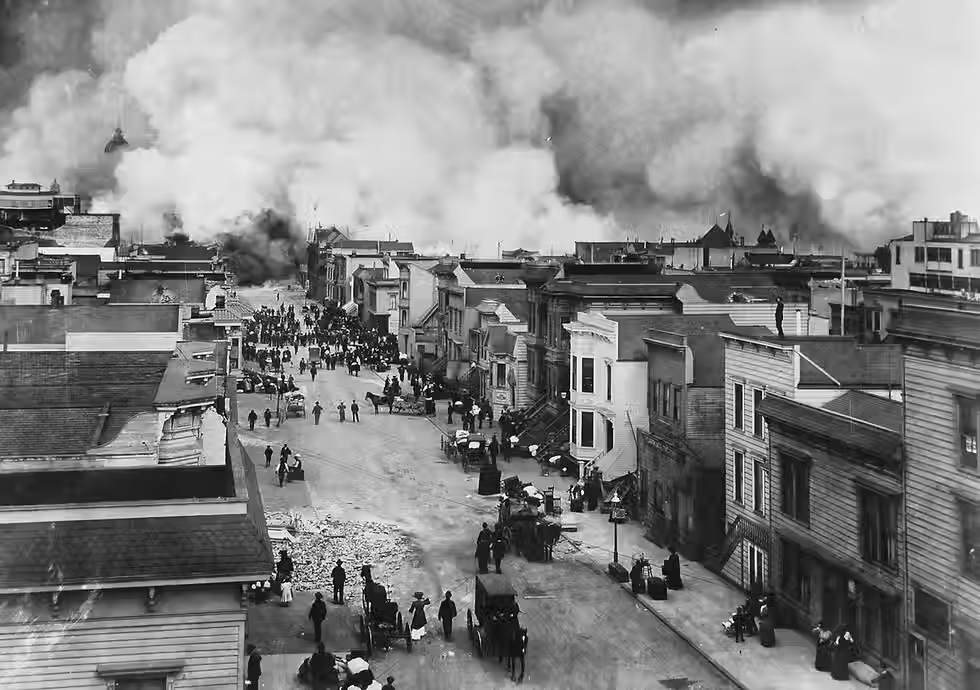
What made the 1906 earthquake so devastating was not just its strength, but the way multiple destructive forces unfolded at once. The rupture along the San Andreas Fault extended for hundreds of miles, producing intense and prolonged shaking that many of the city’s buildings were simply not designed to withstand. At the time, much of San Francisco was built with unreinforced masonry and timber, materials that could not absorb the violent lateral motion. Entire blocks collapsed within seconds, trapping residents and filling the streets with debris.
Even more destructive than the earthquake itself were the fires that followed. Gas lines ruptured across the city, igniting blazes that quickly spread out of control. At the same time, the quake had shattered water mains, leaving firefighters with little ability to contain the flames. For three days, fires burned through neighborhoods, merging into massive firestorms that consumed homes, businesses, and civic buildings. In many areas, desperate measures such as dynamiting buildings to create firebreaks sometimes made matters worse rather than better.
Another factor was the timing and human vulnerability. The earthquake struck just before dawn, when most people were indoors and asleep, increasing the risk of injury from collapsing structures. Communication systems were crippled almost immediately, isolating parts of the city and slowing coordinated emergency response. With transportation disrupted and infrastructure in ruins, relief efforts struggled to keep pace with the scale of the disaster.Finally, the lack of preparedness and limited scientific understanding of earthquakes at the time magnified the impact. There were no seismic building codes, no organized disaster response systems, and little public awareness of how to respond to such an event. The result was a cascading catastrophe—structural collapse, uncontrolled fire, and humanitarian crisis—that together made the 1906 earthquake one of the most devastating urban disasters in modern American history.
For more historic pictures, click the picture of the Mission District.