


FOOD
Click THE TARTAN FOR REGISTRY INFORMATION IF AVAILABLE
CLICK THE PICTURE FOR MORE INTERESTNG INFORMATION!


Green Tea
Carol A.L. Martin
Hot Tea Month
Jan 12
"Tea … is a religion of the art of life."
~ Kakuzo Okakura (1863-1913)
Fancy another cup of tea—perhaps a soothing green? Though tea has been enjoyed since as early as 2700 BC, it wasn’t introduced to the Western world until the early 17th century, when the Dutch East India Company brought back its first shipment of Chinese tea. Today, tea stands as the most popular beverage in the world after water!
Green tea, made from the leaves of Camellia sinensis, is unique in that it skips the withering and oxidation processes used to create oolong and black teas. The result is a delightful range of scents and flavors, from light and sweet to fresh and grassy, with some varieties offering a rich, savory umami profile.
Among the most celebrated is matcha—a finely ground green tea made from tencha, leaves cultivated in the shade to develop a naturally sweet aroma. Matcha is integral to the ritual Japanese tea ceremony and is also used to flavor a variety of desserts. From matcha ice cream to Green Tea Truffles, brownies, and even shortbread, this vibrant flavor has inspired countless treats.
The spectrum of green teas is as diverse as it is beautiful, ranging from the light yellow-green of Gyokuro to the warm orange-green of Houjicha. Captured in this tartan, these hues create a striking design fit to grace any tea ceremony. 💚 🖤 💛 🍵

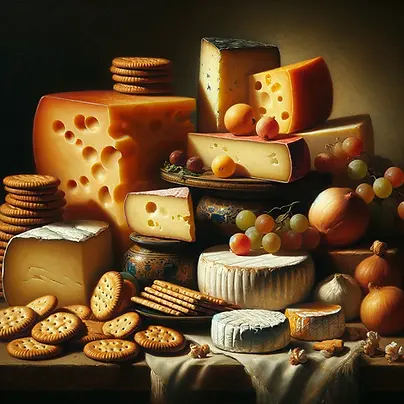
Cheese and Crackers
Carol A.L. Martin
Cheese Day
Jan 20
"Good morning, Sir. Welcome to the National Cheese Emporium!
Customer: Ah thank you my good man.
Owner: What can I do for you, Sir?
C: Well, I was, uh, sitting in the public library on Thurmon Street just now, skimming through 'Rogue Herries' by Hugh Walpole, and I suddenly came over all peckish.
O: Peckish, sir?
C: Esuriant.
O: Eh?
C: 'Ee I were all 'ungry-like!
O: Ah, hungry!
C: In a nutshell. And I thought to myself, 'a little fermented curd will do the trick', so, I curtailed my Walpoling activites, sallied forth, and infiltrated your place of purveyance to negotiate the vending of some cheesy comestibles!
O: Come again?
C: I want to buy some cheese!"
~ Monty Python, The Cheese Shop Sketch, 1972
The perfect tartan for the modern-day cheesemonger, all you need with your kilt would be a sporran full of crackers!
Imbued with the rich colours reminiscent of cheddary yellows, mustards, and poppy-seed crackers, this tartan may appeal to turophiles (cheese-lovers) or simply make you hungry for a snack.
The production of cheese predates recorded history, beginning well over 7,000 years ago. The Romans were fond of cheeses, but considered other dairy products, milk-drinking and butter production, as evidence of barbarism, which they particularly noted in the Germanic and Celtic regions. Most regions throughout history prized their regional cheeses and cheese making techniques and often gave cheeses as special gifts.
During the celebration of her wedding toPrince Albert in 1840, Queen Victoria received the gift of a 1250-pound, 9-foot-diameter cheddar, produced by a cooperative of cheesemakers from two villages. According to a cheese historian, "Perhaps baffled by how to serve it, she sent the cheese off on a tour of England.”
According to those in the know, the UK's most popular cheeses at present are: Cheddar, Double Gloucester, Yorkshire Wensleydale, Shropshire Blue, Lincolnshire Poacher, Y Fenni, Seriously Strong Cheddar, Double Gloucester, Little Black Bomber, Gruyère, Brie, Camembert, Port Salut, Stilton, Gorgonzola, Stichelton, and Stinking Bishop! Say cheese! 💛 🖤 💛 🧀 🧀 🧀


Black Forest Cake
Carol A.L. Martin
Chocolate Cake Day
Jan 27
"A slice of Black Forest cake isn’t just dessert; it’s a love letter written in chocolate, cherries, and cream."
For many, the Black Forest Cake is one of the most delicious chocolate cakes in existence! Bakers or chocolatiers may appreciate this namesake tartan's overall delicious colourways (and resistance to chocolate cake stains as well). Named for the eponymous Schwarzwälder Kirschtorte, this chocolate sponge cake with a rich cherry filling, has achieved even more notoriety as the result of an internet meme based on the video game Portal. In the game, a Black Forest Cake was offered as an incentive to complete an achievement (and is mysteriously referenced several times within the game as "a lie," although the cake actually does appear at the end of the game). Regardless, the catchphrase "The Cake is a Lie" became its own internet meme and slang phrase used to convey the message that "your promised reward is merely a fictitious motivator." According to the game developers, the game cake was inspired by an actual Black Forest cake sold in a bakery near their company headquarters in Bellevue, Washington.
If you're fond of chocolate cake, do you remember these other chocolate cake trends? 1960s "Tunnel of Fudge" Bundt cakes; 1980s Chocolate Decadence cakes; 1990s Chocolate Lava cakes; 2000s artisan Chocolate Cupcakes; and 2010s Flourless Chocolate cakes and tortes; and today's unusual flavour pairings such as chocolate and lavender, chocolate and chili, or chocolate and matcha! 🤎 💗 🖤 🤎 ❤️ 🥮 🍫


Café au Lait
Carol A.L. Martin
Café au Lait Day
Feb 17
"🎶 If I can't take
My coffee break,
Somehow the soul no longer tries,
Gone is the sense of enterprise,
Somehow I can't metabolize,
Something within me dies."
~ "Coffee Break", How to Succeed in Business Without Really Trying, 1961
For all those needing a pick me up at your place of business or just to get going in the morning, grab another cup of coffee or channel the creamy and rich colours of this caffeinated tartan for a visual jolt, perfect for the coffee connoisseur! There was a time when coffee came in one basic style, black, and you added the cream or milk yourself. Today it is easy to be flummoxed by the seemingly infinite coffee variations on the menu at trendy coffee bars. not to mention confounding coffee customs that vary regionally! In the US, a traditional café au lait is made of brewed coffee and steamed milk with a 1:1 ratio, while in Europe, café au lait is made of espresso instead. And American café au lait is often made using scalded, rather than steamed milk, though it is not clear if that is done on purpose. And in France, café au lait is served in a white porcelain cup, while Italian style requires clear glass. Definitely time for a coffee break! ☕☕☕


Mardi Gras
Mardi Gras
Feb 17
"Laissez Les Bon Temps Rouler!"
Let the good times roll! The holidays are coming fast and furious! With a kilt in this tartan, all you need is a sparkly mask, a traditional string of beads, and some pancakes for fortification, and you're ready to join a Mardi Gras parade and revels in style! Shrove Tuesday is traditionally the last day of feasting before the season of Lent and also known as Pancake Day, a day for using up rich foods such as eggs, milk and sugar before the 40-day period of Lent abstinence until Easter. Shrove Tuesday's more boisterous incarnation, Mardi Gras or "Fat Tuesday," is the culmination of the season of Carnival, a final day of excess most famously celebrated with parades and parties in Rio de Janeiro, Brazil; Venice, Italy; New Orleans, United States; São Vicente, Cape Verde; Nice, France; Barranquilla, Colombia; Port of Spain, Trinidad and Tobago; Goa, India; and Quebec City, Canada! In New Orleans, the tradition of flinging gold, purple, and green colored beads to revelers during the many parades inspired the colours in this tartan design symbolizing purple for justice, green for faith, and gold for power! 💜 💚 💛 🥞


Hint o' Mint
Carol A.L. Martin
Chocolate Mint Day
Feb 19
"It is the destiny of mint to be crushed."
~ Waverley Lewis Root (1903-1982)
Chocolatiers and chocolate lovers, take note! This rich, chocolatey tartan - infused with just a hint of mint - is a dream come true for those who love the classic combination of mint and chocolate. The pairing of these two flavours has long fascinated chocolatiers, who early on recognized the complementary fragrance and taste. Whether crafted with milk, dark, or white chocolate, and flavored with peppermint, spearmint, or crème de menthe (made from Corsican mint), every blend has its own distinctive fragrance and taste.
The mint family, which includes basil, thyme, lavender, lemon balm, rosemary, marjoram, and oregano, has a storied history in both culinary and medicinal traditions. Certain aromatic mint varieties are prized for their intriguing scents, which can carry hints of pineapple, grapefruit, apple, ginger. and even chocolate! While some people detect only the familiar coolness of spearmint, others perceive unmistakable chocolate notes, so rich and indulgent that they evoke memories of Thin Mint Girl Scout cookies or Andes Mints!
So the next time a chocolate truffle with mint catches your eye, it could well be in tartan form! Simply irresistible! 🤎 💚 🤎 💚 🍫 🍫 🍫 🌱

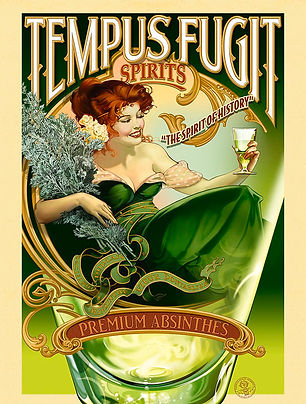
The Green Fairy
Carol A.L. Martin
Absinthe Day
Mar 5
“Let me be mad, then, by all means! mad with the madness of Absinthe, the wildest, most luxurious madness in the world! Vive la folie! Vive l'amour! Vive l'animalisme! Vive le Diable!”
~ Marie Corelli, Wormwood: A Drama of Paris, 1890
Madness! Love! Animalism! Devilry! Have you glimpsed the Green Fairy?
Absinthe, known as la fée verte, is an anise-flavored spirit crafted from a blend of botanicals, most notably Artemisia absinthium (grand wormwood), green anise, sweet fennel, and an array of medicinal and culinary herbs. In 19th-century Paris, absinthe captivated the fashionable elite, becoming so popular that by the 1860s, bars, bistros, cafés, and cabarets embraced l’heure verte—“the green hour”—at 5:00 p.m. Its intoxicating mystique, combined with its depiction in art as the drink of benumbed, inebriated souls, fueled fears of moral decay, leading several countries to ban it in 1915.
Today, science has dispelled much of the hysteria surrounding absinthe’s psychoactive properties. The trace amounts of thujone, once believed to induce hallucinations, are now considered largely harmless. Since the absinthe revival of the 1990s, many modern brands proudly market themselves as thujone-free. And absinthe isn’t just a French affair—Scotland has its own take on the notorious spirit. Mermichan (Scots Gaelic for “Wicked Fairy”) is a unique blend of grand wormwood, green aniseed, fennel seed, hyssop, star anise, lemon balm, mint, lemon thyme, bramble leaves, heather flower, and Deeside honey.
This tartan uses the classic colors of the green of the drink itself, together with the contrasting warmer colours of vintage advertisements for absinthe which were popularized in the Art Nouveau period! Madness, indeed! 💚 💛 ❤️ 🖤 🧚♀️🧚 🧚 ✨


Marmalade, My Toast is Calling
Carol A.L. Martin
Marmalade Days
Apr 26
“Bought marmalade? Oh dear, I call that very feeble.”
~ Lady Trentham, Gosford Park (2002)
Those who are fond of marmalade on toast, definitely have their favourite brands or homemade recipes! Well, now you have a special tartan for your kilted breakfast! Reminiscent of buttered (and ever so slightly burnt) toast, tea and coffee, and one's favourite marmalade, this delectably-coloured tartan will set you up for a brilliant day!
And if you love marmalade, the annual Marmalade Festival & Competition, is being hosted in Dalemain Mansion & Gardens in the Lake District, where amateur and professional marmalade-makers are submitting their delicious concoctions for tasting! This fruit preserve, made from the juice and peel of citrus fruits (usually bitter Seville oranges) and boiled with sugar and water, started out as a combination of fruits including lemons, limes, grapefruits, mandarins, sweet oranges, bergamots, as well as non-citrus. In fact, the word "marmalade" is borrowed from the Portuguese marmelada, from marmelo referring to the quince!
Famous marmalade devotees include Paddington Bear (whose passion for marmalade is well known) and even International Spy James Bond! 007 has marmalade on his toast every morning, as chronicled by Ian Fleming’s 1957 novel From Russia, With Love!
The Scots are credited with developing marmalade into a spread, with Scottish recipes in the 18th century using more water to produce a less solid preserve than older recipes. The Scots also moved marmalade to the breakfast table, and by the 19th century the English followed suit, abandoning the eating of marmalade in the evening. Breakfast, lunch, or dinner. It's a perpetual treat! 🤎 🧡 🖤 🤍 🍊 🍊 🍊 🧈 🧈 🧈 🍞 🍞 🍞


Irn Bru
Kinloch Anderson Ltd
Beverage Day
May 6
"🎶 There was Pepsi, Coke and Vimto,
Ginger Beer and Lemonade
But when they asked me "whit d'ye want"
This is what A said:
Irn Bru, Irn Bru
Built ye up, when ye grew
It's the only thing to do
Drink Irn Bru, Irn Bru, Irn Bru, Irn Bru"
~ Irn Bru, Scocha, 2011
Feeling a bit peckish? There’s nothing quite like a Tunnock’s Tea Cake—and only one proper thing to wash it down with: Irn-Bru, Scotland’s famously cheeky “second favourite drink.”
And now, thanks to this iconically coloured tartan, there’s always the option of kilting up and making the sort of entrance that doesn’t go unnoticed, with colours that call to mind something fruity, fizzy, and lightly spiced.
The story behind this quintessential Scottish soda is a bit more winding than expected. An early version, called Ironbrew, appeared in the United States in 1889, marketed as “the ideal American drink,” with a dark color not unlike its rival, Coca-Cola. By 1898, “Iron Brew” had made its way to Britain via London’s Stevenson & Howell, complete with a memorable strongman trademark—more a general symbol of strength than something tied to any one maker.
Not long after, A.G. Barr produced its own version, built on a distinctive recipe that would ultimately outlast the rest. As the years passed and Irn-Bru became the enduring name, earlier imagery and associations gradually settled around it, even if they did not begin there.
Origins aside, today’s Irn-Bru's flavour profile is rather hard to describe. Common flavor descriptions often mention:
Citrus-forward – often compared to orange soda, though less obvious and more blended
Sweet, almost candy-like – a bright, sugary profile that doesn’t lean too heavy or syrupy
Subtle spice or ginger note – some detect a faint warmth, similar to very mild ginger or spice
Bubblegum / cream soda hints – especially in the aftertaste
Slight metallic tang – not unpleasant, but part of that “iron girders” mystique
As they say, Irn-Bru gets you through! 🧡 💙 🤍 🥤 🥤 🥤


Tarbh Deargh (Red Bull)
unspecified
Beverage Day
May 6
"Red Bull Gives You Wings" ~ Red Bull Slogan
If Irn Bru or Coca Cola don't give you that extra boost (along with their respective matching tartans), you have another non-alcoholic tartan beverage choice - Red Bull! The most popular energy drink in the world, Red Bull was launched in 1987 and owes its origins to a similar drink called Krating Daeng, which was introduced in 1976 in Thailand and marketed towards labourers and students as a means to increase their productivity. Depending on the country, Red Bull contains different amounts of caffeine, taurine, B vitamins (B2, B3, B5, B6, B12) and simple sugars (sucrose and glucose) in a buffer solution of carbonated water, baking soda and magnesium carbonate.


Coca Cola
Janet Helm Presents Tartan
Have a Coke Day
May 8
"Things go better with Coca Cola,
Things go better with Coke!"
~ Coca Cola Slogan (1964)
This corporate tartan was designed as a playful tribute to classic mid-century Coca-Cola advertising. The warm caramel-brown ground evokes the rich color of cola itself, while the fine red overcheck and soft pale blue stripes recall the cool, refreshing palette often seen in 1940s and 1950s soda advertising, diner décor, refrigerators, serving trays, and frosted-glass illustrations.
Since its inception in 1886, Coca-Cola has also been notable for its memorable advertising slogans and catchy campaigns. Revive and refresh yourself with a bubbly caffeinated beverage and see how many famous Coke jingles and slogans are recognizable from over the years!
New campaigns and jingles appeared every few years, often becoming cultural shorthand for an entire era.
Some famous Coca-Cola slogans by generation:
• Traditionalists / Silent Generation (1945 and before)
“Drink Coca-Cola” (1900s–1920s)
“The Pause That Refreshes” (1929)
“Sign of Good Taste” (1950s)
• Baby Boomers (1946–1954)
“Things Go Better with Coke” (1963)
• Generation Jones (1955–1965)
“It’s the Real Thing” (1969)
“I’d Like to Buy the World a Coke” (1971)
• Gen X (1965–1976)
“Coke Adds Life” (1976)
“Have a Coke and a Smile” (1979)
• Millennials / Gen Y (1977–1995)
“Can’t Beat the Feeling” (1988)
“Always Coca-Cola” (1993)
• Gen Z / iGen / Centennials (1996–present)
“Open Happiness” (2009)
“Taste the Feeling” (2016)
And judging by the cheerful colours of this tartan, “Have a Coke and a Smile” may still be perfectly sound advice — particularly for anyone sporting a tartan almost guaranteed to elicit a few smiles of its own. 🤎 💙 ❤️ 🥤 🥤 🥤


Scotch Whisky 1494
Steven Patrick Sim
World Whisky Weekend
May 16
"The proper drinking of Scotch whisky is more than indulgence: it is a toast to civilization, a tribute to the continuity of culture, a manifesto of man's determination to use the resources of nature to refresh mind and body and enjoy to the full the senses with which he has been endowed."
~ David Daiches (1912-2005)
Whisky drinkers ... today's the day to celebrate with whisky lovers worldwide through tastings and other whisky-infused events! Whisky or Whiskey? Currently, spelling conventions dictate that Irish and American whiskeys are spelled with the 'e', while Scottish, Canadian, and Japanese whiskys are spelled without. However, some bourbons and Tennessee whiskies, buck this convention. Created to celebrate Scotch Whisky, fondly referred to as ‘the Water of Life’, this tartan's design embodies the origin story of Scotch - the first written record of whisky production in the Exchequer Rolls of Scotland noted on the 1st of June in 1494 - and also colour references the Tironensian Grey Monks of Lindores Abbey who are credited with the first distillation of 'uisge beatha' (the water of life). Sláinte! 🥃


The Angel's Share
Steven Patrick Sim
World Whisky Weekend
May 16
"Today's rain is tomorrow's whisky."
~ Traditional
It is said that for every barrel of whisky made, the angels — and the devil — get their share! This weekend, raise a glass to the “water of life” with this whisky-inspired tartan, equally at home beside a smooth Highland single malt or something distinctly peaty and smoky from the western isles.
Like a well-aged dram, the tartan weaves together the many elements that give Scotch whisky its character: golden barley fields, dark peat fires, cool Scottish water, oak casks resting quietly in stone warehouses, and the slow passage of time itself. Even the famous “angel’s share” — the whisky lost to evaporation during aging — finds a place in its symbolism, while the “devil’s cut” nods to the spirit absorbed deep into the wood of the barrel.
Whisky and tartan have long shared a place in the romantic imagination of Scotland: craftsmanship, patience, regional character, and traditions passed from one generation to the next. Whether your preference leans toward honeyed Speyside elegance, smoky Islay intensity, or a lively conversation at the end of a country dance, this tartan is ready for the occasion. So pour a wee dram before the angels claim too much of it — and perhaps leave a little for the devil as well. Slàinte! 💛 🤎 🧡 🖤 💙 👼 🥃


Cool as a Cucumber
Carol A.L. Martin
Mint Julep Day
May 30
"A cucumber should be well sliced, and dressed with pepper and vinegar, and then thrown out, as good for nothing."
~ James Boswell, The Journal of a Tour to the Hebrides (1785)
This humorous quote from Boswell's book The Journal of a Tour to the Hebrides with Samuel Johnson, LL.D. (1785), recounts the 1773 journey Boswell taken through the Scottish Highlands and islands with the famed English writer Dr. Samuel Johnson, known for his wit, strong opinions, and suspicion of uncooked vegetables. We respectfully disagree with Dr. Johnson!
On a sweltering summer day, few things evoke a sense of cool, crisp refreshment like the subtle crunch of a cucumber sandwich or the icy sting of a mint julep, ideally served with a twist of cucumber for an extra touch of garden freshness. Though Dr. Johnson’s biographer Boswell may have had other ideas about tea accompaniments, many find cucumber's soothing qualities and imagery the perfect counterpoint to heat.
And why not a visually refreshing tartan to cool the eye of the onlooker! This seasonal and verdant tartan, with its spring and summery cool green tones and fresh white accents, was inspired by the visual essence of a classic mint julep garnished with a cool cucumber!
The mint julep—an American classic combining bourbon, simple syrup, shaved ice, and muddled mint—has become synonymous with the Kentucky Derby, famously served at Churchill Downs since the race's beginnings in 1875. This storied event, dubbed “The Most Exciting Two Minutes in Sports,” marks the start of the Triple Crown each May and has helped elevate the mint julep from Southern staple to national symbol of springtime indulgence. Over the years, creative twists have emerged, and the addition of cucumber has become a favorite—bringing not only flavor but a cooling clarity that mirrors the sensation of shade on a hot afternoon. 💚 💛 🤍 💚 🥒 🥒 🥒 🧊 🧊 🧊 🥃


Blue Cheese
Carol A.L. Martin
Cheese Day
Jun 4
“A silence fell at the mention of Gavard. They all looked at each other cautiously. As they were all rather short of breath by this time, it was the Camembert they could smell. This cheese, with its gamy odour, had overpowered the milder smells of the Marolles and the Limbourg; its power was remarkable. Every now and then, however, a slight whiff, a flute-like note, came from the Parmesan, while the Bries came into play with their soft, musty smell, the gentle sound, so to speak, of a damp tambourine. The Livarot launched into an overwhelming reprise, and the Géromé kept up the symphony with a sustained high note.”
– Émile Zola, The Belly of Paris. 1873
For the true Turophile (cheese-lover), this vivid description of the olfactory sensations experienced upon entering a cheese shop, has become known in literary circles as the "Cheese Symphony" due to its ingenious orchestral metaphors. Cheese have been so prized throughout history, that they have been formally awarded titles or special designations such as "King of Cheeses." Various cheeses have held this title in different centuries including: Parmigiano Reggiano, Brie de Meaux, Roquefort. Époisses, Stilton, and Cheddar while Brie has been more generally known as the "Queen of Cheeses." Blue cheeses, semi-soft cheese with sharp, salty flavours, made with cultures of the edible mold Penicillium, is recognized by its blue and green spots or veins which run throughout the chees. According to legend, one of the first blue cheeses, Roquefort, was discovered when a young boy, eating bread and ewes' milk cheese, abandoned his meal in a nearby cave after seeing a beautiful girl in the distance. When he returned months later, the mold (Penicillium roqueforti) had transformed his cheese into Roquefort! But beware of cheesy imposters, because many blue cheeses such as Roquefort, Danablu, Cabrales, Gorgonzola and Blue Stilton carry a protected designation of origin! Should your taste for the blue veer towards the home country, some blue cheeses of Scottish origin include: Hebridean Blue (Isle of Mull), Biggar Blue, Strathdon Blue, Lanark Blue, Dunsyre Blue, and Blue Murder! 🧀


Juniper
Carol A.L. Martin
Gin Day
Jun 13
“When life gives you juniper berries, make gin!”
Gin and tonic and tartan, anyone? The pungent blue-black berries of the verdant juniper bush lend their distinctive flavour to gin, a spirit whose roots stretch back centuries. Today, you can indulge in the tartan equivalent, with deep rich colours that hint at juniper berries, ready for harvest.
Although gin is most closely associated with Britain today, its origins lie in Europe, where juniper-flavoured spirits were first developed for medicinal purposes. By the seventeenth century, gin had become a popular alternative to heavily taxed brandy in the British Isles. While Scotch whisky would later dominate Scotland's distilling reputation, the early twenty-first century saw a remarkable Scottish gin renaissance. Hundreds of craft distilleries emerged, drawing upon Scotland's pure water, centuries of distilling expertise, and native botanicals such as heather, pine, rowan berries, bog myrtle, seaweed, gorse, and thistle.
Today, Scotland is one of the world's leading producers of craft gin. Distilleries such as Hendrick's, The Botanist, Edinburgh Gin, and Caorunn have earned international acclaim, creating distinctive spirits that capture the character of their local landscapes. The classic gin and tonic remains a favourite, joined by enduring cocktails such as the Martini, Negroni, Tom Collins, Gimlet, and Gin Fizz.
Juniper has long figured in folklore and tradition. In British folklore, the smoke of burning juniper was believed to purify and protect, and was sometimes thought to aid in seeing the future. Curiously, while dreaming of a juniper tree itself was considered unlucky, dreaming of gathering juniper berries in winter was said to foretell prosperity, honour, and good fortune.
Juniper also holds an honoured place in Scottish tradition. A sprig of juniper forms part of the regimental uniform of the Atholl Highlanders, the only private army in Europe. As the clan plant of the Atholl family, a sprig of juniper is ceremonially presented by the Duke of Atholl during his annual inspection of the regiment! 💚 🖤 💙 🍸 🍸 🍸 🌿 🌿


Whiskey & Bourbon
Edgar Van de Grommert
Bourbon Day
Jun 14
“If I cannot drink Bourbon and smoke cigars in Heaven then I shall not go.”
~ Mark Twain (1835-1910)
Both Scotch and Bourbon get their names from their place of origin. While Scotch whisky is made only in Scotland, Bourbon whiskey hails from Bourbon County, Kentucky. Although there is no one real inventor, Elijah Craig (Baptist minister by day) is generally credited with the innovation of aging corn whiskey in a charred oak barrel in 1789. Per the American Bourbon Association, in order to be classified as bourbon, a whiskey needs to be distilled from a mixture of grains, or mash, that's at least 51 percent corn, which gives it its distinctive sweet flavor. Although there are variations, bourbon aging must take place in a new, charred, oak barrel (which gives the vanilla flavour and the dark colour) and must be aged for at least two years to be considered a straight bourbon. One the barrel has been used, it can no longer be used for bourbon making and many barrels end up in Scotland for aging Scotch! Cheers, Sláinte, and To Your Health! 🌽 🥃


Wasabi
Carol A.L. Martin
Sushi Day
Jun 18
"Wasabi
green wasabi burnt
ginger a little too sweet
sake should be warm"
~ Wasabi Haiku, Jim Greenhow, 2016
Along with soy sauce and pickled ginger, this tartan provides a perfect accompaniment to a kilted night out for sushi! Whether you're favouring nigiri, sashimi, maki, uramaki, or temaki, this lovely green Wasabi tartan will provide just the right amount of bite! Real Wasabi (Japanese horseradish), is rarely encountered outside Japan due to availability, pricing and its ephemeral tasting properties. Wasabi's spicy effect comes from a chemical reaction that occurs after grating, but this reaction is short-lived. After 5 minutes the spicy flavour peaks and by 30 minutes almost all the flavour is gone. For these reasons, one is most likely to be familiar with "western wasabi" a mixture of white horseradish, mustard, starch, and green food coloring or spinach powder! Regardless of origin, because the burning sensations of horseradishes are not oil-based, they are short-lived compared to the effects of capsaicin in chili peppers, and are washed away with more food or liquid. Inhaling or sniffing wasabi vapor has an effect like smelling salts, a property exploited by researchers attempting to create a wasaabi-vapor smoke alarm for the deaf! 🍣🥢


Blue Lemon Martini
Carol A.L. Martin
Martini Day
Jun 19
"There is something about a Martini,
A tingle remarkably pleasant;
A yellow, a mellow Martini;
I wish I had one at present.
There is something about a Martini,
Ere the dining and dancing begin,
And to tell you the truth,
It is not the vermouth—
I think that perhaps it's the gin."
~ A Drink With Something In It, Ogden Nash (1902-1971)
Cheers, tartan enthusiasts! Those whisky-hued tartans have a colourful interloper in their midst, and one with origins in the classic mid-century modern cocktail, the Martini!
A classic Martini—gin and vermouth served in a distinctive V-shaped glass and garnished with either a green olive or a twist of lemon—reached the height of its popularity in the late 1950s and 1960s. During this era, the legendary "three-martini lunch" became a symbol of the cosmopolitan executive and sophisticated urban lifestyle. Variations on the theme soon emerged, including the Kangaroo, which substituted vodka for gin, and the Gibson, which replaced the olive garnish with a cocktail onion. Perhaps the most famous variation of all was James Bond's preferred Vesper—a potent blend of gin, vodka, and Kina Lillet, finished with a twist of lemon peel.
By the 1970s, colourful and sweeter interpretations such as the Lemon Drop and Blue Lemon Martini had become staples of the then fashionable fern bars, appealing to a new generation of cocktail enthusiasts who favored fruitier and more colourful drinks.
Today, the Martini's influence can be seen in countless descendants, from the ubiquitous Appletini and Lycheetini to the indulgent Mochatini.
Although purists may shudder, Whiskey and whisky have also found their way into the Martini family. A Whiskey Martini typically replaces gin with American rye whiskey or bourbon while retaining dry vermouth, creating a drier cousin to the classic Manhattan.
Scotch whisky enthusiasts may prefer a Scotch Martini, made with Scotch and dry vermouth, often garnished with a twist of lemon. Related cocktails include the Rob Roy, which combines Scotch whisky with sweet vermouth, and the Smoky Martini, which adds a splash of peaty Scotch to a traditional gin Martini.
Whatever your preference, from a peaty Highland malt to a classic gin Martini, here's to good company and good stories. 💙 💛 💚 🥃🍸🍸🍸


Cuppa Tea
Tartan Caledonia
Sponge Cake Day
Jun 26
"Afternoon tea should be provided, fresh supplies, with thin bread-and-butter, fancy pastries, cakes, etc., being brought in as other guests arrive."
~ Mrs Beeton's Book of Household Management, Isabella Beeton, 1861
Bakers, tea drinkers, and dessert lovers, this tartan looks delicious enough to serve on a cake stand! Designed to complement a tea blend from a tea company, this vanilla cream tartan evokes layers of golden sponge cake, raspberry jam, creamy marzipan, and the comforting tones of tea and coffee. In fact, if tartans came with calorie counts, this one might require a warning label. Fortunately, unlike a Victoria sponge, you can admire it as often as you like without worrying about a second helping!
There's nothing quite as refreshing as a cup of tea, especially when accompanied by a sweet treat such as sponge cake. Light and airy, sponge cakes are traditionally made from eggs, flour, and sugar, with their delicate texture created by beaten eggs acting as a natural raising agent. While most sponge cakes contain both egg whites and yolks, some varieties, such as angel food cake, use only the whites. The sponge cake as we know it today emerged in the mid-18th century, when bakers began relying on whipped eggs to create a lighter cake.
A major development came in 1843 when English food manufacturer Alfred Bird introduced baking powder, making it possible to add butter to the traditional recipe and leading to the creation of the famous Victoria sponge, or Victoria sandwich cake. Named after Queen Victoria, who was said to enjoy a slice with her afternoon tea, the original version was simply filled with jam, although modern recipes often add a generous layer of cream as well.
Whether your preference is for a classic Victoria sponge, a neat slice of Battenberg, or just another cup of tea, this tartan serves up all the charm of the tea table without a crumb to clean up afterwards! 💛 🤍 🤎 💗 🫖 🍰 🍰 🍰


Vanilla Cream Tea
Cream Tea Day
Jun 26
“My hour for tea is half-past five, and my buttered toast waits for nobody.”
~ Wilkie Collins, The Woman in White, 1859
The color of black tea, vanilla bean, and a candied rose-petal, this tartan might make you long for a bit of buttered toast or a Cream Tea, scones, clotted cream, jam, and of course, and of course, a cup of tea. And speaking of scones, where do you stand on the Scone Wars? The difference between how one treats one's scones - the Cornish and the Devonshire style cream tea - can be the cause of much controversy at tea time. The Devonshire (or Devon) method is to split the scone in two, cover each half with clotted cream, and then add strawberry jam on top. While in Cornwall, a cream tea may be traditionally served with a "Cornish split", a type of slightly sweet white bread roll, rather than a scone. Either way, the warm roll (or scone) is first buttered, then spread with strawberry jam, and finally topped with a spoonful of clotted cream. Strong opinions? Well then, we'd best not get into the pronunciation of "scone"! It's almost tea time! 🍵 🍞 🍓


Blueberry Muffin
Carol A.L. Martin
Muffin Day
Jul 11
Jack: "How you can sit there, calmly eating muffins when we are in this horrible trouble, I can’t make out. You seem to me to be perfectly heartless."
Algernon: "Well, I can’t eat muffins in an agitated manner. The butter would probably get on my cuffs. One should always eat muffins quite calmly. It is the only way to eat them."
~ The Importance of Being Earnest, Oscar Wilde, 1895
Forget your troubles today with an English or American-style muffin! And if there's a muffin worthy of tartan, the quintessential blueberry muffin makes a striking statement with its purply richness. The purplish blue of the native blueberry is created by phytochemicals known as anthocyanins, responsible for the colour and resultant naming of the fruit in many languages. The "blue berry" directly translates to many languages including the Scots blaeberry and the Norwegian blåbær likely because apart from blueberries, bluefish and blue corn, the color blue is rare amongst edible plants and animals. Ripe blueberries have a light green flesh, while their berry cousins, bilberries, whortleberries and huckleberries are red or purple throughout. Native Americans referred to blueberries as “star berries” because of the star-shaped blossoms and made a beef jerky called Sautahig similar to pemmican, but substituting the cranberries with dried blueberries. While muffins retain their original form in the UK (a light yeast-leavened bread, cooked on a griddle and flipped, resulting in the classic flattened shape), across the pond muffins evolved to a form and texture similar to cupcakes, with both sweet and savoury flavours. Either way, pass the butter! 🫐 🧈


Ice Cream
Carol A.L. Martin
Ice Cream Day
Jul 20
"I guess ice cream is one of those things that are beyond imagination. "
~L.M. Montgomery, Anne of Green Gables, 1908
Is there anything better than ice cream on a summer's day? Not much, perhaps some sorbet, or sherbet, or gelato, or kulfi or more ice cream! Since 500 BC in ancient Persia, frozen dessert ices were enjoyed by combining ice (obtained from mountains and returned to the warmer climes by runners) to be mixed with rosewater, saffron, or fruits to create desserts for royalty. By the 17th century, Charles I of England was reportedly so impressed by the "frozen snow" that he offered his own ice cream maker a lifetime pension in return for keeping the formula secret, so that ice cream could be a royal prerogative! It was not until the late 18th and 19th centuries that ices and ice creams became accessible to the common folk via printed recipes and specialty ice cream parlours. Neapolitan ice cream (also known as Harlequin ice cream) whose sweet colourways are deliciously designed into this tartan, was first introduced in the United States in the 1870s as an ice cream version of Spumoni, the Italian fruit and nut layered dessert representing the Italian flag: Green for pistachio or almond, White for vanilla, and Pink/Red for cherry! Remember, "You scream! I scream! We all scream for ice cream! Yum, yum ! 💗 🤍 💚 🤎 💗 🍨 🍦


Cowtown
Ed Easter
Cowboy Day
Jul 27
"The cowboy has been called America’s folk hero — a symbol of the frontier spirit, rugged individualism, and quiet strength."
The mythos of the American cowboy—especially in Texas—blends rugged individualism, frontier grit, and a deep-rooted sense of freedom, forming one of the most enduring symbols of American identity. More than just folk heroes, cowboys played a critical role in shaping the American West: they drove massive cattle herds across treacherous terrain, established vital trade routes, and supported the growth of frontier towns that would later become major cities.
This tartan was designed to celebrate the history of Fort Worth, Texas, ‘the Gateway to the West’. Colours: dark blue and brown are based on the colours on the Fort Worth flag; the two yellow lines are intended represent the 8 pointed stars of the 2nd Dragoons, the original force stationed at the fort; blue is for the Trinity River; black is for the panther of Panther City; green is intended to represent the wealth and industry brought by the railroad and white on blue is intended to represent the Saltire and the rich Scottish heritage of the region. 🧡 💙 💚 💛 🤍 🖤 🤠 🐄 🐄 🐄 🐎 🐎 🐎

Jacobite Old
Battle of Killiecrankie
Jul 27
The final and least successful use of the Highland charge (a battlefield shock tactic used by the clans of the Scottish Highlands which incorporated the use of firearms) was in 1746 during the final confrontation of the Jacobite rising of 1745, the Battle of Culloden. With the introduction of muskets and cannon, the previous tight formations used by highlanders with their heavy axes and claymores, became vulnerable. As a result, Highlander warriors developed a lighter, one-handed basket-hilted broadsword that protected the hand. This was generally used with a shield or targe strapped to the weak arm and a dirk or biotag "long knife" held in the other hand.The charge required a high degree of commitment as the men were rushing into musket range and would suffer casualties from at least one volley. Speed was essential, so the Highlanders preferred to employ the charge downhill and over firm ground; they removed clothing from their lower body for the same reason. They ran forward in clusters of a dozen (often blood relatives) which formed a larger wedge shaped formation. Once in effective musket range (60 yards) those with firearms would shoot; gun-smoke from this mass discharge having obscured enemies' aim, the Highlanders obtained further protection from the expected return volley from the opposing force by crouching low to the ground immediately after firing. Then, firearms were then dropped and edged weapons drawn, whereupon the men made the final rush on the enemy line with a Gaelic battle cry.


Scotch Whisky
Steven Patrick Sim
Scotch Day
Jul 27
"Depend na on the doctor's skill,
His powder, potion, or his pill;
For black draught tank' the blue - a gill
O' guid auld Highland Whisky O"
~ Highland Whisky, Traditional, air to "Niel Gow's Farewell to Whisky"
Ach, and who's not in need of a double these days? If you're the type who knows your Glenlivet from a Glenfiddich and your Bruichladdich from a Bunnahabhain, then double down with this beautiful whiskied tartan because it's Scotch Whisky Day! This tartan was designed to celebrate the water of life (uisge beatha) and to pay tribute to the ‘Spiritual home of Scotch’ reckoned by some as Lindores Abbey, Fife, where the first written record of whisky production was noted in the Exchequer Rolls of Scotland in 1494. Considered to be the industry's founding document, it records Brother Cor, a ‘Grey Monk’ of the Tironensian Order, being charged with the commission of making "acqua vitae" by King James IV. This tartan uses the following colours: Blue for the pure Scottish water used to make the spirit, the three stripes representing the ‘Holy Burn’, the water source used by the Monks of Lindores Abbey; Dark Grey represents John Cor and the robes of the Tironensian Order; Russet Brown represents the traditional oak cask used for maturation, the shade between the brown and grey alluding also to the copper pot still; Ochre represents the ‘eight bolls of malt’, the shade between the ochre and grey representing the yeast; Yellow and Amber combine to represent the Scotch Whisky itself, with yellow shades in the tartan representing the ancient barley fields surrounding Lindores Abbey. Slainte! 🥃 🥃


The Mead of Poetry
Layton James Bertsch
Mead Day
Aug 2
"An attendant stood by
With a decorated pitcher, pouring bright
Helpings of mead.
And the minstrel sang,
Filling Heorot with his head-clearing voice,
Gladdening that great rally of Danes and Geats."
~ Beowulf (c 975-1010 AD), translation by Seamus Heaney
Celebrate the Lughnasa summer harvest with a tartan celebrating one of the world's oldest alcoholic beverages and perhaps you too, can wax poetical, inspired by this heady and sweet brew! Mead, fermented honey wine, was often called “nectar” or “ambrosia", and is infused with the sweetness and floral essences of summer. Once a favourite beverage across many ancient cultures, it faded from prominence during the Middle Ages, when improved farming practices made grain-based brews like beer more economical, and the later influx of West Indian sugar reduced the practical incentives for beekeeping.
However, mead is enjoying a vibrant revival in modern times, thanks in part to the influence of fantasy literature and gaming. Series like Game of Thrones have helped reawaken interest in this storied drink, casting it once again as a beverage of heroes, poets, and mythical feasts. Alongside contemporary craft versions, traditional meads have reemerged, offering intriguing variations. These include Acerglyn, infused with maple syrup; Black Mead, made with black currants; Bochet, which features caramelized or even scorched honey for a deep, rich flavor; and Braggot, a hearty blend of mead and malted grain, often barley.
In Norse mythology, mead holds legendary significance. It is said to grant eloquence, poetic inspiration, and the power of wisdom. The magical Mead of Poetry was created through a tale of violent deception involving giants, dwarves, and the cunning god Odin. Two distinct types of mead are born in the myth: a lesser brew known as the “rhymester’s share,” and the coveted Mead of Suttungr, said to bestow upon the drinker the power to become a skald or sage—able to solve any question and speak with inspired fluency.
So choose your mead wisely. You may not become a scholar overnight, but at the very least, you might find yourself composing a rather respectable verse or two. 💙 🤍 🖤 💛 ❤️ 🍯 🐝🍷


Champagne Celebration
Carol A.L. Martin
Champagne Day
Aug 4
“Pleasure without champagne is purely artificial.”
~ Oscar Wilde (1854-1900)
On August 4th, we raise a glass to the sparkling legacy of Dom Pérignon and the legendary moment in 1693 when he is said to have exclaimed, “Come quickly, I am tasting the stars!” Though not the actual inventor of champagne, Pérignon played a key role in refining the process—and his name remains forever entwined with the effervescent charm of this celebratory wine. Ironically, his original task was to eliminate the bubbles, which were once considered a fault. But as tastes evolved and people began to crave the sparkle, Pérignon embraced the fizz, pioneering key innovations in champagne production. He introduced techniques to boost natural carbonation, standardized practices to prevent cellar explosions, and made the drink safer with thicker bottles and rope snares to hold corks firmly in place.
Like its namesake tartan, champagne itself comes in a range of beautiful hues, each as festive as a summer sunset. The most iconic is pale gold, like sunlight in a flute, but there are deeper golden and amber shades in older vintages. Rosé champagnes shimmer from soft blush to coppery salmon, adding romantic warmth to the glass. Blanc de Blancs, made solely from Chardonnay, often gleam with a golden-green tint—cool and crisp like morning light on fresh grass—while Blanc de Noirs, from Pinot grapes, glow with a rounder, richer tone. Whether shimmering silver-gold or tinged with pink, each hue captures a different mood—perfect for summer celebrations under the sun or stars.
So on this warm August day, whether you're summer-kilted in sparkling champagne tones or something more traditional, find a reason to celebrate and let the cork fly! Cheers! 🤎 💛 🤍 💗 💚 🍾 🍾 🍾 🥂 🥂 🥂


Milk and Cookies
Carol A.L. Martin
Chocolate Chip Cookie Day
Aug 4
"There once was a cookie so sweet,
Who loved when with milk it would meet.
They danced in a cup,
Then took a big gulp,
A pair that no treat could defeat!"
Hey there, kilt-wearing Cookie Monsters! If the delicious smell of chocolate chip cookies baking fills you with nostalgia and makes you long for a glass a creamy rich milk to wash them down, you are not alone! A kilt or apron in this Milk and Cookies tartan would be the perfect complement for an avid baker, cookie taster, or aspiring biscuit shop owner, and will easily hide any chocolatey stains. Chocolate chip cookies, this most classic of drop cookies, is a worldwide favorite! American chefs Ruth Graves Wakefield and Sue Brides in 1938 invented the recipe at the Toll House Inn in Whitman, Massachusetts. According to cookie historians, they had been serving a thin butterscotch nut cookie with ice cream, but decided to innovate and added chopped up bits from a Nestlé semi-sweet chocolate bar!! An instant favourite, Wakefield allegedly gave Nestle the recipe and was compensated with a lifetime's supply of chocolate! Artisan cookies became popular in the late 1970s and 1980s with many brands competing for the top cookie spot. And it became especially popular for bakers to attempt reverse engineering the "secret recipes" of many brands, especially the California based Mrs. Field's chocolate chip cookie, whose secret recipe has never yet been divulged! But with so many cookie recipes to try, with a few simple ingredients and a cold glass a milk, you're all "sett"! Yum Yum! 🤎 🖤 🤍 🤎 🥛 🍪


Sir Harry Lauder (Commemorative)
Robert David pool
Sir Harry Lauder Day
Aug 4
"🎶 Roamin' in the gloamin' on the bonnie banks o' Clyde,
Roamin' in the gloamin' wi' ma lassie by ma side,
When the sun has gone to rest, that's the time that I like best,
O, it's lovely roamin' in the gloamin'!"
~ Roamin' in the Gloamin', Harry Lauder, 1911
The tartan celebrates the 150th anniversary of Sir Harry Lauder's birth in 1870, his achievements within the entertainment industry and his WWI fund raising efforts. Lauder's success in leading the Howard & Wyndham pantomime at the Theatre Royal, Glasgow, for which he wrote I Love a Lassie, made him a national star, and he obtained contracts with Sir Edward Moss and others. Gaining initial success for his humour and singing first to fellow miners in Hamilton, Lanarkshire, Harry eventually became an entertainer full-time and went on to became on of the world's most popular entertainers during a career which spanned 42 years. He undertook several world tours including trips to the US, Canada, New Zealand, and Australia. Lauder wrote most of his own songs, favourites of which were Roamin' In The Gloamin', I Love a Lassie, A Wee Deoch-an-Doris, and The End of the Road, which is used by Birmingham City Football Club as their club anthem. The Corkscrew hazel ornamental cultivar of common hazel (Corylus avellana 'Contorta') is sometimes known as Harry Lauder's Walking Stick, in reference to the crooked walking stick (cromach) Lauder often carried, dressed in full Highland regalia. 🎭 🎶


Assam
Sazaby League
Afternoon Tea Week
Aug 12
“There are few hours in life more agreeable than the hour dedicated to the ceremony known as afternoon tea.”
~ Henry James, The Portrait of a Lady, 1881
From a wide selection of tartans inspired by the origins and flavours of the world’s favourite brewed beverage, this richly coloured design pays tribute to Assam tea.
Grown in the India’s northeastern Assam region, this tea is celebrated for its bold character, deep amber liquor, and distinctive malty aroma! The climate of the Brahmaputra River valley, with its humid summers and monsoon rains, produces leaves that yield a strong, full-bodied cup—perfect for breakfast blends and robust afternoon teas. Long prized by tea connoisseurs, Assam’s hearty flavour stands up well to milk and sugar, making it a staple in traditional British tea culture. This tartan captures that same richness in its warm, earthy palette, echoing both the fertile soil and the deep tones of a freshly poured cup.
The charming ritual of afternoon tea—whether enjoyed simply or accompanied by an array of sweet and savoury delights—has experienced a revival since its beginnings in the 1840s. Its creation is credited to Anna, the Duchess of Bedford, who found the long gap between lunch and the evening meal left her prone to “hunger spells.” Seeking a remedy, she began requesting tea and light refreshments in the afternoon. Once she invited friends to join her, the custom quickly blossomed into a fashionable social occasion among the aristocracy.
By the 1920s, afternoon tea had reached the height of its popularity, often staged as an elaborate affair with numerous guests, liveried servants, silver teapots, crisp linens, elegant china, live music, and, of course, the finest tea that money could buy. Traditionally served between three and five o’clock, it became a cherished pause in the day for both conversation and indulgence.
So although liveried servants and live music may be lacking, pausing for an afternoon cup of tea and a biscuit will serve admirably, whether it's tea for two or tea just for you. ❤️ 💜 💙 🤍 🤎 🫖 🍵

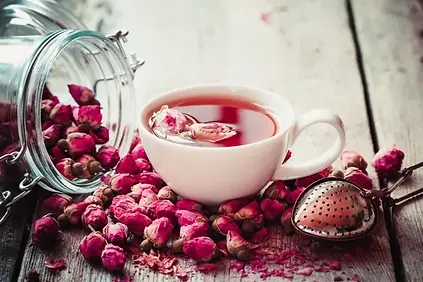
Rose Tea
Sazaby League
Afternoon Tea Week
Aug 12
“There are few hours in life more agreeable than the hour dedicated to the ceremony known as afternoon tea.”
~ Henry James, The Portrait of a Lady, 1881
If it's not yet teatime, it soon will be! The delightful pastime of afternoon tea, especially with sweet and savoury accompaniments, has undergone a revival since its origins in the 1840s. Credit is given to Anna, the Duchess of Bedford, who, because of the long stretch of time between lunch and the evening meal in aristocratic circles, suffered from afternoon "hunger spells." Once she began sharing her delightful new habit of taking tea with friends, it soon it progressed into a full-blown social event amongst society. By the 1920s, afternoon tea was the height of fashion, complete with silver teapots, fine linens, musicians, elegant teacups, and the best tea money could buy! Traditionally, afternoon tea is any time between three and five o'clock. Should it be near that time, why not try a cup of something other than a traditional black tea. Rose Tea, which inspired this floral- hued tartan. is made from the petals or rosehips (the fruit of the rose plan), and has a calming effect, beautiful fragrance, and plentiful antioxidants and vitamin C! 🌹 🌱☕️ 🌱

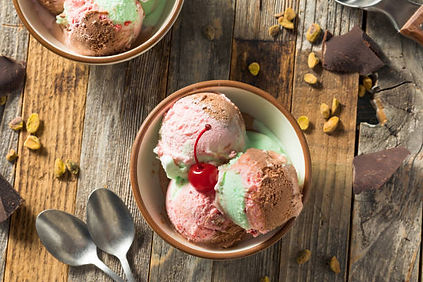
Gelato
Carol A.L. Martin
Spumoni Day
Aug 21
"🎶 Chocolate chip and everything that's nice;
Tutti-frutti once and spumoni twice!"
~ Louis Prima, "Banana Split for My Baby", 1951
Spumoni - Chocolate, Cherry, and Pistachio gelato! Are you a fan, or might you have you been traumatized in childhood by versions with little bits of candied fruits or nuts? If so, it's time to revisit Gelato is ice cream's creamier, smoother and silkier, Italian cousin. First popularized in Naples, Gelato is now popular in places with large Italian immigrant populations, as in the U.S. and Argentina. While both gelato and ice cream contain cream, milk and sugar, authentic gelato uses more milk, less cream and generally doesn’t use a custard base from egg yolks, common in ice creams. Italian gelato is also served warmer than traditional ice creams so that your mouth is better able to taste the melted flavours, enhanced by lower butterfat content. Traditional Spumone (from the word spuma for "foam"), and its plural spumoni, is a molded gelato, sliced rather than scooped, and a staple dessert in Italian culture after a dinner of ravioli and braciole. Mangia! 🍨 🇮🇹


Peaches
Carol A.L. Martin
Peaches Day
Aug 24
"The ripest peach is highest on the tree."
~ James Whitcomb Riley (1849-1916)
This tartan is truly “peachy keen”! For more than three centuries, English speakers have used “peach” and “peachy” to describe things that are exceptionally good, desirable, and attractive—often even charming young ladies. Anyone donning this delectably hued tartan is sure to turn heads!
The peach itself has a long and fascinating journey. First cultivated in China, it traveled through Persia before making its way to Europe. The Ancient Romans dubbed it malum persicum (“Persian apple”), while its scientific name, prunus persica, translates as “Persian plum.” Belonging to the same family as cherries, apricots, plums, and almonds, the peach is set apart by its velvety fuzz, a clever natural defense against pests and rot. Its smooth-skinned cousin, the nectarine, lacks this soft shield—though the two occasionally mingle, producing a delightful hybrid known as the peacherine.
So alluring was this fruit that it even inspired the King of Ragtime, Scott Joplin, who composed his lively Peacherine Rag in 1901. With such history and sweetness woven into its story, this tartan captures not only the charm of the peach but also its playful spirit. 🧡 💛 🤎 🍑 🍑 🍑 🥧


Blackberry
Carol A.L. Martin
Blackberry Day
Sep 12
"O, blackberry tart, with berries as big as your thumb, purple and black, and thick with juice, and a crust to endear them that will go to cream in your mouth, and both passing down with such a taste that will make you close your eyes and wish you might live forever in the wideness of that rich moment."
~ How Green Was My Valley, Richard Llewellyn, 1939
This is purple prose you can almost taste. Deep violet tones and berry-rich hues spill across this tartan, evoking bowls of cream and every shade of bramble fruit. The sett feels luscious, layered, and ripe with flavor.
Blackberries, brambles, bumble-kites, brummel, bly, brameberry, scaldhead, brambleberry—whatever you call them, September 12th marks Blackberry Day, the traditional moment in the English Midlands when the fruit reaches perfect ripeness. Miss the harvest, and folklore warns you not to delay too long. By October 11th—Old Michaelmas Day, sometimes called Devil’s Spit Day—the berries are said to turn bitter and spoiled.
Legend tells that when St. Michael cast Lucifer out of heaven, the fallen angel landed in a blackberry bush. In his fury he scorched the fruit with his fiery breath, stamped upon it, spat on it, and left it cursed. From that day on, the berries were no longer fit to eat after Michaelmas. As a result, the last of the season’s fruit often found its way into a Michaelmas blackberry pie, a farewell to the year’s sweet bounty.
This tartan pays tribute to that rich tradition with thread colours named “Blackberry,” “Blackcurrant,” and “Honey Flower.” Woven together, they create a feast for the eyes—scrumptious, decadent, and delightfully purple. 💜 🖤 🤍 💜 🫐 🫐 🫐 😈


Strong Brew
Carol A.L. Martin
International Coffee Day
Oct 1
"I'm feeling mighty lonesome
Haven't slept a wink
I walk the floor and watch the door
And in between I drink
Black coffee
Love's a hand me down brew
I'll never know a Sunday
In this weekday room."
Feeling a bit groggy and reaching for that morning cup of coffee or this bold tartan equivalent? Well, it's hard to believe that this beloved pick-me-up was once met with suspicion and even outright hostility! In days gone by, coffee (unlike its more 'respectable' cousin, tea) was seen as a dangerous foreign brew that could throw the drinker’s constitution into chaos! Back in 1674, a group of concerned British women took this fear to new heights. Their “Women’s Petition Against Coffee” boldly claimed that coffee was turning their husbands into “useless corpses,” and they proposed a ban on it for anyone under the age of 60. Meanwhile, in other parts of the world, governments sought to ban coffee for its supposed ability to stir up radical thinking. Sweden, in 1746, took matters to an extreme by banning not just coffee but also coffee paraphernalia—cups, saucers, and all! Today, coffee is the most consumed hot beverage in the world, with a dizzying array of varieties on offer. From rare artisanal roasts grown on high-altitude farms to specialty blends costing a small fortune, coffee connoisseurs have no shortage of options. And now, you have this rich tartan to wake-up and dazzle the decaffeinated in line at your nearest coffee bar! One might even say (in coffee-house speak) that this sumptuous brew boasts whispers of sun-kissed cocoa beans, a flirtation with wildflower honey, and the faintest hint of freshly rained-upon forest leaves. Its aroma carries notes of nostalgia wrapped in a blanket of warm, artisanal dreams. With each sip, you'll taste the dedication of handpicked moonlit berries and the essence of a thousand poets sighing in unison. Or, you know... let's just call it a good strong brew. 🤪 🖤 🤎 🖤 ☕ ☕ ☕


Cinnamon Bun With Icing
Carol A.L. Martin
Cinnamon Bun Day
Oct 4
"Beautiful Cinnamon Roll Too Good For This World, Too Pure"
~ The Onion
Warm, buttery, gooey cinnamon rolls are beloved sweet treats in North America and northern Europe. These delectable buns have become so cherished that Sweden and Finland celebrate Cinnamon Roll Day (Kanelbullens dag) every year. In Denmark, they're known as kanelsnegl, or "cinnamon snails," adding a regional twist to their charm. Despite their different names and variations, the cinnamon bun gained internet fame in 2014, thanks to a satirical article in The Onion titled, "Beautiful Cinnamon Roll Too Good For This World, Too Pure." This phrase quickly became a meme to describe lovable, sympathetic fictional characters who endure hardships despite their inherent goodness. Regardless, they are practically irresistible whether in real life or in this strangely enticing tartan form! Delicious! With Icing! 🤎 🖤 🧡 🤎 🤍 🥐


Oatmeal in a Blue Bowl
Carol A.L. Martin
World Porridge Day
Oct 10
"In boilin' water, salted weel,
'Tween fingers rins the ruchsome meal,
While the brisk spurtle gars them wheel
In jaups an' rings -
Ae guid half-hour, syne bowls may reel
Wi' food for kings."
~ Scotch Porridge, Robert Bird
Fuel up with a bowl of brochan lom—a smooth and hearty oatmeal porridge that has long been one of the most traditional ways to start the day. The tartan inspired by it carries the soft visual texture and natural shading of porridge's warm colours, evoking the look of steel-cut or pinhead oats in a favourite blue bowl!
Not all “porridge,” however, has been so comforting. When Sir Arthur Conan Doyle visited a First World War armaments factory at Gretna, on the Scottish border, he famously described the workers’ dangerous concoction of nitroglycerine and gun-cotton as “the Devil’s Porridge.”
World Porridge Day offers the perfect celebration for more traditional and creative versions. Each year in Carrbridge, a small village in the Scottish Highlands, cooks gather for the World Porridge Making Championships. The victor walks away with the coveted golden spurtle— the slender wooden mixing stick that has stirred Scottish porridge for centuries.
This year in the specialty category, the champion turned porridge into a toasted sandwich (jaffle). She invented a yoghurt flatbread that could cook within competition time, then filled it with rum-flavoured bananas, oatmeal, wattle seed, and Davidson plum sugar!
With a history of porridge-eating that stretches back thousands of years, it’s no surprise that lore and superstition have clung to it as well. One old belief insists you must always stir your porridge clockwise—lest you risk inviting the devil himself to breakfast! So whether you take yours traditionally plain with only a bit salt, favour mid-century modern additions of butter, cream and brown sugar, today's fashion of nuts and berries, or something more exotic, eat up! We need fuel for the day! 💙 💛 🤍 🤎 🏆 🥣 🥣 🥣


Berry Patch
Carol A.L. Martin
Old Michaelmas
Oct 11
"Roly poly pudding, and blackberry pie.
Peter likes the pudding, and Polly likes the pie!"
~ Traditional
If you haven't gathered your blackberries by today, Old Michaelmas Day or Devil's Spit Day, you may be out of luck. It is said that when St. Michael and all Angels threw Lucifer (the Devil) out of Heaven, and he fell to earth straight into a blackberry bush. Scratched by the thorns, he cursed the bush and spat on it (or worse) making the fruit unfit to eat! The Devil notwithstanding, by mid-October, many of the remaining berries on the bushes are likely spoiled by insect damage and molds and smuts, making this tradition a sensible calendrical guideline for seasonal and safe berry picking. The devil is always in the details. 👿


Drambuie Hunting
Liqueur Day
Oct 16
"Stop. Isn't it time for a Drambuie on ice?"
~ Drambuie slogan, 1960s
Stop! And thank you, Clan MacKinnon! If not for you, according to legend, we would not have this honeyed Scotch whisky liqueur, with its secret (and perhaps royal) blend of herbs and spices! Supposedly, after his terrible defeat at the battle of Culloden, Bonnie Prince Charlie received sanctuary from John MacKinnon on the Isle of Skye. In gratitude (or battle shock), the prince passed a royal recipe to his host. MacKinnon may have coined the drink's name, from the Gaelic phrase “An Dram Buidheach,” meaning “the drink that satisfies" though its literal meaning "yellow hills" hints more at the recipe ingredients. Though many people have tried to duplicate the secret recipe, using clues from various sources, aside from a few probables – scotch, heather honey, herbs, saffron – the recipe remains secret and safe! Many do-it-yourself-recipes include cloves, nutmeg, cinnamon, angelica, fennel, or rosemary in an attempt to try to duplicate the special taste. Well known cocktails using Drambuie include the "Bonnie Prince Charlie", the "Rusty Nail", and "Scotch Coffee"! 80 Proof! Slàinte! 🥃 👑


Arbroath Smokie
Smokehouse Day
Oct 19
"Little sticks of wood are stuck into the haddock gills, and two by two, tied tail to tail, they are hung on little wooden spits high up in the old fashioned lums." ~ Marian McNeill, The Scots Kitchen, 1929 "
Smoke 'em hot! Smoke 'em cold! Smoking food is an ancient practice dating back to the Paleolithic era used to preserve meat and fish and to add flavor and colour. Arbroath Smokies and Finnan Haddock (also known as Finnan Haddie) both originate from the East coast of Scotland and start with freshly caught haddock. One fundamental difference is that the Arbroath Smokie is hot-smoked (cooked) and ready to eat whereas Finnan Haddie is cold-smoked and therefore requires cooking before eating. Finnan haddie originated in medieval times in the Scottish village of Findon. Traditionally the haddock was smoked with green wood and peat. The Arbroath Smokies originated in the village of Auchmithie, but in the nineteenth century, a number of the community of Auchmithie moved down the coast to settle in the larger town of Arbroath to take advantage of the larger harbour, giving the town's name to the traditionally hot-smoked haddock. In this tartan, red represents the sandstone of Arbroath Abbey where the Declaration of Independence was signed in 1320; blue and white represent the sea; the lighter red the glow of the smokie barrel and the golden yellow of the delicacy itself.🔥 🐟 🔥


Chili Pepper
Carol A.L. Martin
Chili Cook Off Championships
Oct 19
"They have hot peppers in Louisiana.
Little red devils with fire in their skin
and hell in their seeds."
~The Grains of Paradise, James Street (1903–1954)
Spice it up! Championship Chili Cookoff Competitions are taking place all over the US and beyond! The origins of the modern stewed dish known as "chili" are murky, but by the 1920s, chili was a standard menu item on diners and chili parlors were popular throughout the western United States. Traditional chilis were flavoured with vintage green and red chili peppers from Mexico including jalapeños, cayenne and ancho, but the newer chili peppers of today are on another level for hotness! The now infamous Ghost Pepper, unknown in the west until the year 2000 is commonly used in chili recipes but also in recipes for candy, fudge, vodka and more! However, this pepper now ranks only the 8th in the world for heat, and can be found in plant nurseries for vegetable gardens. This formerly frightening pepper trails the fearsomely named Carolina Reaper, Trinidad Moruga Scorpion, t7 pot Douglah, "Butch T" Trinidad Scorpion, Naga Viper, and the newest truly deadly peppers, the "Dragon's Breath Chili" and "Pepper X" ! The Dragon's Breath Chili was an accidentally bred pepper by a gardener in Wales who was breeding for a more attractive plant, and the newest record holder Pepper X was bred by same breeder who originated the Carolina Repeater! These peppers rate 2.5 million and 3.2 million on the Scoville scale, the standard measure of the heat, or pungency, of chili pepper. These peppers are deadly and may have only medical uses as nerve anesthetics in calibrated doses. For comparison, a Bell pepper rates a 0 on the Scoville Heat Unit scale (no heat) , a jalapeño pepper ranges between 2500 - and 10000, and a Scotch bonnet (named for its resemblance to a Scottish tam o' shanter bonnet) or habanero ranges between 100,000 and 350,000! Beware! 🌶️🌶️🌶️


The Porter Drinkers
Thomas Kinding
Stout Day
Nov 6
“Whoever drinks beer, he is quick to sleep;
whoever sleeps long, does not sin;
whoever does not sin, enters Heaven!
Thus, let us drink beer!”
~ often attributed to Martin Luther (1483-1546)
Now, that's some fine Reformation logic! And speaking of beer and ale, fancy a pint? How about a porter drinker's tartan, perfect for a 16th-century alehouse or your neighborhood pub today!
Stout and porter are dark beers that share a rich history with unique identities that set them apart. Stout is a dark, top-fermented beer known for its variations—dry stout, oatmeal stout, milk stout, and the powerful imperial stout. Originally, “stout” simply meant a “strong” beer rather than dark. Over time, however, its association with deeply roasted flavors and darker hues evolved, especially as stouts became recognized for their bold, rich taste.
Milk stouts, also known as sweet or cream stouts, rose to fame in Britain after WWI and were even touted as nourishing, popular among nursing mothers. Today, stouts range from comforting chocolate and coffee notes to inventive twists like Maple Bacon or Choc Lobster, flavored with sea salt, basil tea, and even lobster!
Porter, on the other hand, traces its name back to the sturdy London deliverymen who carried kegs to pubs, announcing themselves with a hearty shout of “Porter!” Though porters are often milder than stouts, today they’re known for their smooth, toasty, sometimes caramel-like sweetness.
Porter has deep roots in Sweden, arriving in the late 1700s and brewed in Gothenburg from 1813. The city’s lively overseas trade helped it thrive—most famously through merchant David Carnegie, whose grandfather served Bonnie Prince Charlie before taking refuge in Gothenburg after Culloden. David carried that legacy forward, buying a sugar refinery and porter brewery in 1836 and cementing Sweden’s porter tradition.
The Porter Drinkers’ tartan, honors this Swedish history and the character of the beer itself: rich black for the dark, full-bodied brew, warm yellow for its gentle sweetness, and a fine red line echoing the distinctive tang beloved by porter fans. Mind your p's and q's! Cheers! 🖤 💛 🤎 ❤️ 🍺 🍺 🍺


Smooth Merlot Blend
Carol A.L. Martin
Merlot Day
Nov 7
“At its best, Merlot tastes like velvet. It is pure plushness — deep fruit, plush texture, and gentle grace.”
~ The Wine Bible, Karen MacNeil
For those who love the deep, rich tones of a thoughtfully poured glass of wine, perhaps a velvety Merlot, this grape and grapevine-coloured tartan is the perfect pairing!
Though its name recognition and popularity has increased over the last decades, Merlot was first mentioned by a Bordeaux official in 1784 who pronounced this varietal "one of the finest of its time." Originally used as a blending grape, it is now the fourth most widely planted grape behind Chardonnay, Cabernet Sauvignon, and Pinot Noir.
And for those who take their tartans and wine appreciation seriously, Merlot is generally acknowledged to occupy a balanced place in the red-wine world, offering both richness and elegance! It typically feels smoother, rounder, and softer on the palate, while Cabernet Sauvignon is more structured, firmer, and tannic. And compared to Pinot Noir, Merlot is generally fuller-bodied, richer, and darker-fruited, whereas Pinot Noir is lighter, more delicate, higher in acidity, and often shows more red-fruit and earthy notes.
Merlot's popularity was impacted by a single line from the dark 2004 comedy film Sideways, when ill-tempered wine snob character Miles, who has a reverence and passion for Pinot Noir, can't abide one more offering of Merlot on a visit with friends to California's wine country in Santa Barbara. Miles eventually loses him temper and explodes with the line, "If anyone orders Merlot, I'm leaving, I am NOT drinking any #$@&%*! Merlot!" His outrageous tasting room antics drew laughs from audiences but also had a fascinating effect on wine consumption!
Though there was a temporary negative impact on the consumption of Merlot, it increased the sales of Pinot Noir (which was praised in the film), and an increase in red wine consumption overall! This statistical phenomenon is now known as the "Sideways Effect." Cheers! 💚 💜 🖤 💜 🍇 🍇 🍇 🍷


Cappuccino
Carol A.L. Martin
Cappuccino Day
Nov 8
"Cappuccino, Frappuccino, Mochaccino, Al Pacino ..."
~ Coffee jump rope song
Is it too late for a Cappuccino? No worries, coffee drinkers, this richly designed and roasted coffee-bean tartan with just a hint of milky crema will catch the approving eye of exacting coffee drinkers any time of the day!
If the words "Caramel Frappuccino with almond milk and a shot of espresso" have never passed your lips, you may be a coffee purist. Or perhaps you also follow the Italian Food Rules, and would never order a cappuccino except in the mornings.
Italians believe the fresh whole milk that makes up over half of the contents of this drink plays havoc with digestion. Depending on your locale, to order a cappuccino after 10am, unless you are breakfasting late, may subject you to a raised eyebrow, a worried shake of the head, or outright ridicule!
The cappuccino receives its name from the red-brown colour of the hooded robes worn by monks and nuns of the Capuchin order in 17th century Europe.
To improve your Italian coffee credentials, remember to drink your cappuccino while it is hot and the foam is still there, or if you must have a variation, order the cappuccino scuro, a cappuccino made with less milk. And if you’re wearing this tartan, go ahead — order that cappuccino after 10am. All eyes will be on your kilt, not your milk content. 🤎 🖤 🤍 🤎 ☕ ☕ ☕


Cranberry
Carol A.L. Martin
Cranberry Sauce Day
Nov 26
"It has been an unchallengeable American doctrine that cranberry sauce, a pink goo with overtones of sugared tomatoes, is a delectable necessity of the Thanksgiving board and that turkey is uneatable without it."
~ Alistair Cooke (1908-2004)
Gentle readers, please disregard all such disdainful remarks and scurrilous rumours about tomatoes! Cranberry sauce is a traditional and requisite Thanksgiving side dish, considered by many an absolute necessity on the holiday table—if for nothing else, then as a bright splash of colour and a subconscious threat to guests to mind the clean tablecloth.
Both loathed and loved, cranberry sauce is for many the culinary equivalent of a Christmas fruitcake: a foodstuff whose absence is sorely missed, even if guests aren’t particularly enthusiastic when it actually appears.
Cranberry sauce may have inherited its less-than-stellar reputation from its 20th-century canned form, ceremoniously rolled out for many a mid-century modern Thanksgiving table. And although there are elegant chutneys and citrusy, brandied, or spiced recipes aplenty, for some it simply wouldn’t be Thanksgiving without opening that tin of wiggling, jiggling cranberry jello.
Cranberries are grown in peat-rich bogs primarily in the northern United States. Because they’re difficult to harvest from the vine, the bogs are flooded at harvest time, allowing the berries to float to the top, where they can be gathered for seasonal sauces, tarts, pies, and crumbles. Enjoy this beautiful, rich cranberry and boggy tartan equivalent, which would grace any Thanksgiving table and happily defy any and all cranberry-sauce spills! ❤️ 💜 💗 🖤 🦃 🥧


Thanksgiving
Unknown
Thanksgiving Day in the United States
Nov 27
"May love and laughter light your days,
and warm your heart and home.
May good and faithful friends be yours,
wherever you may roam.
May peace and plenty bless your world
with joy that long endures.
May all life's passing seasons
bring the best to you and yours!"
~ Traditional
American Thanksgiving as we know it today owes much to the persistence of Sarah Josepha Hale, the 19th-century editor, writer, and influential advocate often called the “Mother of Thanksgiving.” Though harvest feasts had long been observed in various colonies, it was Hale who spent decades lobbying presidents, governors, and the public to establish a unified national holiday that celebrated gratitude, family, and American abundance. Her efforts succeeded during the Civil War when President Abraham Lincoln, moved by her appeals, proclaimed a national day of Thanksgiving in 1863 — a tradition that has continued ever since.
Over time, Thanksgiving also absorbed older harvest imagery, and one of the most enduring symbols is the Horn of Plenty, or cornucopia. This emblem of nourishment and abundance long predates the American holiday, appearing in ancient Greek and Roman mythology in connection with deities of the harvest, prosperity, and the fertile earth — from Gaia (or Terra) to Plutus, the child god of riches and son of Demeter, to the nymph Maia, and Fortuna, the bringer of luck and prosperity. The cornucopia’s deep roots in these traditions make it a fitting symbol for a celebration centered on gratitude and plenty.
This richly coloured design was inspired by the plenty of an autumn harvest, using "pumpkin", "corn", "corn harvest" and other seasonal shades. May the richness of the season be yours and yours to share with friends and family.🤎 🧡 💛 💚 🦃 🦃 🦃 🍁 🌽 🥧


Spice Apple
Clinton Mills
Apple Pie Day
Dec 3
“Good apple pies are a considerable part of our domestic happiness.”
- Jane Austen (1775-1817)
’Tis the season for mulled cider’s cozy warmth and the comforting aroma of apple pie! If you could distill the holiday season into pure, vibrant color, you might end up with something very much like this radiant Christmas-coloured tartan. Its festive palette calls to mind tart red apples simmering with cinnamon, nutmeg, allspice, ginger, cardamom, and cloves—the very spirit of Christmas. Or for Christmas carolers, this tartan would be perfect with a warming cup of spiced cider (complete with its ceremonial cinnamon stick), just the thing to inspire those ambitious high notes!
But while you’re savoring all these delicious associations and pouring over apple pie recipes, you may also find yourself wandering into one of the great culinary debates of the season: should apple pie be topped with cheese?
Fans of the tradition can be found worldwide, but its true strongholds lie in the American Midwest, New England, parts of Canada, and Britain. In Yorkshire, Wensleydale was the classic pairing, while early New England settlers reached for colonial Cheddar. Today, the tradition lives on through recipes that welcome everything from Wensleydale and Cheddar to Gouda, Gruyère, Roquefort, or even Parmesan.
So now only two questions remain: would you don this appley-dappley tartan? And ... would you like a slice of cheese with that? ❤️ 💚 💛 🍎 🍏 🥧 🧀

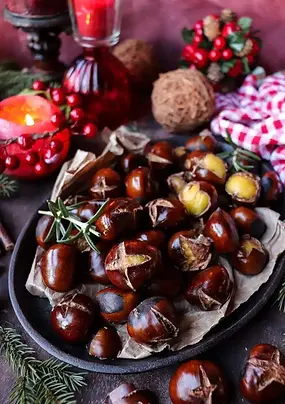
Chestnut
Carol A.L. Martin
Roasted Chestnut Day
Dec 14
"🎶 Chestnuts roasting on an open fire
Jack Frost nipping at your nose
Yuletide carols being sung by a choir
And folks dressed up like Eskimos ..."
~ The Christmas Song, Robert Wells and Mel Tormé, 1945
The delicious aroma of roasted chestnuts is a beloved fixture of the holiday season, drifting through winter air and signaling warmth, comfort, and celebration. Long valued in many cultures, chestnuts have been used in both sweet and savory dishes for centuries, prized for their gentle sweetness and creamy texture rather than the oily richness of most nuts.
In Victorian London, chestnuts occupied a curious place in street-food culture. Regular costermongers rarely dealt in oranges and chestnuts; instead, these were sold by a smaller group of specialty vendors offering oranges, roasted chestnuts, and walnuts. Despite their popularity, these sellers were grouped with watercress-women, sprat-women (who sold foraged fish), and winkle-dealers (sea snails), and were considered socially beneath the typical costermonger—a reminder of the era’s strict market hierarchies.
Behind the scenes of this winter tradition stands the chestnut tree itself, a long-lived and generous presence in European landscapes. Sweet chestnut trees (Castanea sativa) can live for hundreds of years, producing glossy brown nuts each autumn that have sustained both people and animals through lean seasons. In many regions, chestnuts were once known as “bread of the poor,” ground into flour when wheat was scarce.
Today, chestnuts are treated as seasonal delicacies, turning up in creamy soups, festive stuffings, pies, and cakes. Candied chestnuts are sold as the French marrons glacés or the Turkish kestane şekeri (“sugared chestnuts”), while puréed chestnuts folded with sugar and whipped cream form the elegant French dessert Mont Blanc. Whether roasting over an open fire or transformed into holiday sweets, chestnuts remain one of winter’s most enduring and comforting flavors.
And speaking of chestnuts and their tribute tartan, they also have been immortalized in "The Christmas Song", better known by its opening line -
"chestnuts roasting on an open fire", one of the most enduring Christmas songs of the 20th century!
The song was written in 1945 by Mel Tormé and Bob Wells during a sweltering summer in Los Angeles. Wells reportedly jotted down cozy winter images—chestnuts roasting, Jack Frost nipping, carols being sung—as a way to mentally cool off, and Tormé quickly set those images to music. What began as a simple evocation of winter comfort soon became a holiday classic.
Although several artists recorded early versions, it was Nat King Cole who cemented the song’s place in Christmas history. His smooth, intimate 1946 recording (and later re-recordings in the 1950s and 1960s) defined the song’s warm, nostalgic tone and helped turn it into a seasonal staple. 🤎 💛 💚 ❤️ 🌰 🌰 🌰


Fruitcake
Curious and Unusual Tartans
Fruitcake Weather Day
Dec 15
Oh my, it's fruitcake weather!”
~ A Christmas Memory, Truman Capote, 1956
Already? The season of the polarizing fruitcake is upon us! Few desserts inspire such fervent admiration—or such deep disdain—as this holiday staple.
Often prepared in advance of holiday festivities on Stir Up Sunday, the Sunday before Advent, fruitcakes and plum puddings are often soused periodically during this time to give them time to mellow (and that special flavour).
Love them or hate them, fruitcakes packed with sugar and alcohol are famously long-lived. Some can last for years—sometimes even centuries—and a few antique examples have become cherished family heirlooms. Journalist Russell Baker once joked that he owned a fruitcake baked in 1794 by a long-deceased relative as a Christmas gift for President George Washington. According to the tale, Washington returned it with a witty note, explaining that it was “unseemly for Presidents to accept gifts weighing more than 80 pounds, even when only eight inches in diameter.”
If you prefer a Scottish twist, the Dundee cake offers a lighter and less divisive alternative. This nineteenth-century favorite is said to owe its signature almond topping to Mary, Queen of Scots, who reportedly disliked glacé cherries and requested blanched almonds in her cakes instead.
Altogether, this holiday tartan of tradition includes the colors—and flavours—of classic fruitcake ingredients, finished with a generous visual (and spirited) nod to your favorite liquor. Kilt up and souse away! 🤎 💗 💚 💛 ❤️ 🍰 🍍 🍐 🍋 🍒


English Breakfast
Sazaby League ICL Company
The Boston Tea Party (1773)
Dec 16
"The liberties of our country, the freedom of our civil constitution, are worth defending against all hazards: And it is our duty to defend them against all attacks."
~ Samuel Adams (1722-1803)
English Breakfast, Scottish Breakfast, Irish Breakfast tea—or maybe a cup of coffee this morning? Tea drinking in American culture is more than a tempest in a teapot; it reflects a dramatic shift that began in the tense years before the American Revolution. That change took root with the introduction of the Townshend Acts by the British government in 1767, which placed taxes on tea and made this everyday staple less affordable for the colonists. As a result, cheaper tea was widely smuggled into America.
Matters escalated further in 1773 with the passage of the Tea Act. This law granted the East India Company a monopoly on tea sales in the colonies, allowing it to sell tea at prices lower than both colonial importers and smugglers. Rather than calming tensions, the move enraged colonists, who viewed it as another blatant assertion of British control.
That anger boiled over during a midnight raid in Boston Harbor, when tea cargo was dumped into the water in an act of protest now known as the Boston Tea Party. In the wake of this event, and as resistance to British taxation intensified, tea drinking itself became unpatriotic in the American colonies.
Boycotts of tea led many colonists to embrace alternative beverages, including coffee and herbal infusions made with peppermint, sage, or dandelion. That shift stuck. To this day, coffee remains more popular than tea in the United States. So—put the kettle on, or brew a pot of coffee—whatever suits your revolutionary or loyalist fancy! 💙 💚 ❤️ 💛 🤍 🇺🇸 🫖 🇬🇧


Damson
West Coast Woolen Mill
Sugar Plum Day
Dec 18
"'Twas the night before Christmas, when all through the house
Not a creature was stirring, not even a mouse;
The stockings were hung by the chimney with care,
In hopes that St. Nicholas soon would be there;
The children were nestled all snug in their beds;
While visions of sugar-plums danced in their heads"
~ A Visit from Saint Nicholas, Clement Clarke Moore, 1823
December 18th marks the 1892 premiere of Tchaikovsky’s The Nutcracker ballet, beloved for its Christmas setting and the magical music and dances of the Land of Sweets, including the iconic Dance of the Sugar Plum Fairy.
Damson plums generally refer to plums native to Great Britain. Both sweet and tart, they lend themselves beautifully to jams, baking, and the distillation of spirits. During the 18th century, the word plum—a nod to the fruit’s sweetness and richness—came to describe anything pleasing, desirable, delectable, or rich. Plummy, meaning “full of plums,” was even used to describe rich, mellow voices. However, having a “mouthful of sugar plums” suggested sweet words that might not be entirely sincere.
The “sugar plums” so famously described in Clement Clarke Moore’s The Night Before Christmas as visions “dancing” in children’s heads referred to a comfit-like candy popular in the 19th century. These treats were made by repeatedly pouring liquid sugar over a seed—often cardamom or caraway—or an almond, allowing each layer to harden before adding the next. Despite their name, sugar plums contained no plums and no fruit at all, retaining only the round shape of their plummy namesake. 💜 💚 💙 🤍 💛 💜 🍭 🍭 🍭


Wildflower Honey
Carol A.L. Martin
Honey Day
Dec 18
"🎶 She's as sweet as Tupelo honey
She's an angel of the first degree
She's as sweet, she's as sweet as Tupelo honey
Just like honey, baby, from the bee"
~ Tupelo Honey, Van Morrison, 1971
Buzz, buzz, busy bees! Honey figures in many holiday recipes, bringing the sweetness of summer to wintry candlelit desserts of honeyed cookies, honeyed mead wines and honey cakes. As one of the first and most widespread sweetener used by man, honey was highly valued and often used as a form of currency, tribute, or offering. Peasants even paid their feudal lords in honey and beeswax! The bards of old called Britain the “Isle of Honey” due to the sheer number of wild bees flying to and fro. Bees figured prominently in the ancient folkore of Britain, and particularly Scotland, in the concept of "bee souls." It was believed that the soul could leave the body in the form of a bee while a person was sleeping! Whether used for cosmetics, recipes or beverages, wild harvested honey is imbued with the essence and therapeutic properties of the flowers from which the bees visit, including acacia, tea tree, Mānuka, clover, sage, thyme, orange flower, and others, each with its own properties, delicate scents and flavours. With a dollop of honey and butter on toast, muffin or scone, one can enjoy one of life's more delectable of simple pleasures. Thank you, bees! 🤎 🧡 💛 🤎 🐝 🍯