


Click the tartan to view its entry in The Scottish Registers of Tartans which includes registration details, restrictions, and registrant information.
Unregistered tartans may link to one of the web's online design environments for similar information.
For any questions about reproduction of designs or weaving of these tartans, please contact the registrant directly or via this website.
POW/MIA Recognition Day
“You Are Not Forgotten.”
Today in the United States, National POW/MIA Recognition Day is a time to remember American prisoners of war and, especially, those service members who went to war and never came home—those whose fate remains unknown and whose families have lived with questions that may have lasted for decades. Around the world, other countries also remember their own prisoners of war and those who remain missing or unaccounted for.
The Left Behind tartan was created in remembrance of those who are still unaccounted for, regardless of country. Its name is particularly poignant: it speaks not only of those who were left behind in distant places, but also of the families, friends and fellow service members left behind at home, waiting for answers.
Each of the tartan's colors carries a meaning. Red represents the blood that has been shed for their respective country, while dark red represents love for their country, family and loved ones. Black represents darkness, and grey represents the sadness felt by their loved ones.
But the sett also includes blue, representing hope that they may one day be reunited.
POW/MIA Recognition Day is therefore not simply a remembrance of the past. For families still awaiting answers—in the United States and around the world—the story remains unfinished.
You Are Not Forgotten. ❤️ 🖤 💙 💛 🎗️ 🎗️ 🎗️

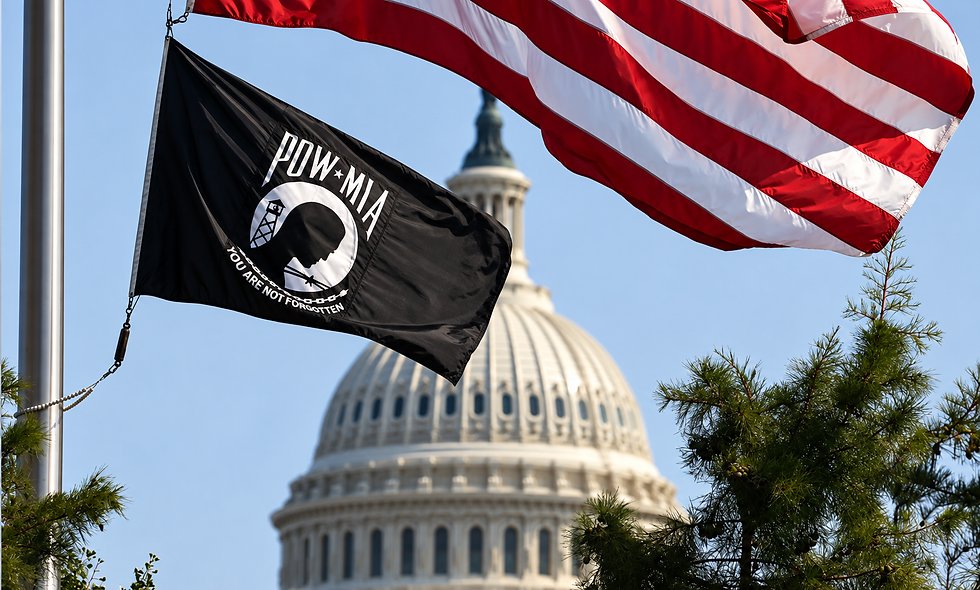
National POW/MIA Recognition Day grew in large part from the determined efforts of families who wanted answers about loved ones who had been taken prisoner or had never returned from war. In the years following the Vietnam War, families of missing American service members pressed the government and the public to ensure that those still unaccounted for were neither forgotten nor quietly left behind.
The first National POW/MIA Recognition Day was observed in 1979, following a proclamation signed by President Jimmy Carter. Its purpose was both remembrance and commitment: to honor those who endured captivity, to remember those who remained missing, and to recognize the families who had often spent years—or decades—waiting for answers. The observance eventually became fixed on the third Friday of September, and every president since Carter has issued an annual proclamation marking the day.
The familiar black-and-white POW/MIA flag predates the official day. Created for the National League of POW/MIA Families in the early 1970s, it became a national symbol of concern for prisoners and the missing. Congress later formally recognized it as a symbol of the country's commitment to determining, as fully as possible, the fate of those who remained unaccounted for.
Perhaps the most important aspect of the day is that it is not simply a memorial to the past. The work of locating, recovering and identifying missing service members continues, sometimes allowing families to receive answers many decades after a war has ended. In that sense, “You Are Not Forgotten” represents more than remembrance—it reflects an ongoing promise to those who did not come home and to the families who continued to wait.
For on this year's ceremonies click the flags.