


Click the tartan to view its entry in The Scottish Registers of Tartans which includes registration details, restrictions, and registrant information.
Unregistered tartans may link to one of the web's online design environments for similar information.
For any questions about reproduction of designs or weaving of these tartans, please contact the registrant directly or via this website.
Flag Day (US)
“Resolved, that the flag of the United States be thirteen stripes, alternate red and white; that the union be thirteen stars, white in a blue field representing a new constellation.”
~ Continental Congress on June 14, 1777
Happy Birthday to the American Flag!
Known by many names—including The Stars and Stripes, The Red, White, and Blue, Old Glory, and The Star-Spangled Banner—the American flag is one of the most recognizable national symbols in the world. It has inspired songs, stories, artwork, and even the United States' national anthem, whose title comes from the flag that continued to fly over Fort McHenry during the War of 1812.
This tartan was designed for the last major celebration, the bi-centennial of 1976, as a response to a suggestion that there should be an identifying tartan for American St Andrews and Caledonian societies. Where the lighter stripes cross each other in the dark blue, there is an effect of the stars of the American flag. The thirteen alternate red and white stripes appear in the full sett of the tartan. This tartan started life as the American Bi-Centennial but was then modified and the name changed to American St Andrews Societies.
In terms of the history of the American flag, the first official national flag was approved by the Continental Congress on June 14, 1777, during the American Revolution. Its design featured thirteen stripes representing the original colonies that declared independence from Great Britain, along with thirteen stars representing the new states. While many meanings have since been attached to the flag's colors, the red, white, and blue were inherited from earlier British and colonial flags and were not originally assigned any official symbolism.
As the young nation expanded westward and new states joined the Union, the flag evolved along with it. Since 1777, there have been 27 official versions of the Stars and Stripes, with stars added to reflect each new state. The current 50-star flag was adopted on July 4, 1960, following Hawaii's admission as the fiftieth state.
Today, Flag Day commemorates the adoption of the flag and celebrates more than two centuries of American history. Across the country, communities mark the occasion with ceremonies, patriotic displays, parades, concerts, and fireworks as they honor the enduring symbol of the nation. ❤️ 🤍 💙 🇺🇸 🎉 🎂 🎆 🎆 🎆

Notes from the Scottish Registry of tartans:
Designed in response to an idea put forward by Mr JC Thomson in 1974, that there should be an identifying tartan for American St Andrews and Caledonian societies. Where the lighter stripes cross each other in the dark blue, there is an effect of the stars of the American flag. The thirteen alternate red and white stripes appear in the full sett of the tartan. This tartan started life as the American Bi-Centennial but was then modified and the name changed to American St Andrews Societies.
Perhaps the oldest continuing Flag Day parade is in Fairfield, Washington. Beginning in 1909 or 1910, Fairfield has held a parade every year since, with the possible exception of 1918 and 2020, and celebrated the centennial parade in 2010, along with other commemorative events. Appleton, Wisconsin, claims to be the oldest National Flag Day parade in the nation, held annually since 1950.
Quincy, Massachusetts, has had an annual Flag Day parade since 1952 and claims that it "is the longest-running parade of its kind" in the U.S. From 1967 to 2017, the largest Flag Day parade was held annually in Troy, New York, which based its parade on the Quincy parade and typically drew 50,000 spectators. In addition, the Three Oaks, Michigan, Flag Day Parade is held annually on the weekend of Flag Day and is a three-day event. It claims to have the largest flag day parade in the nation as well as the oldest
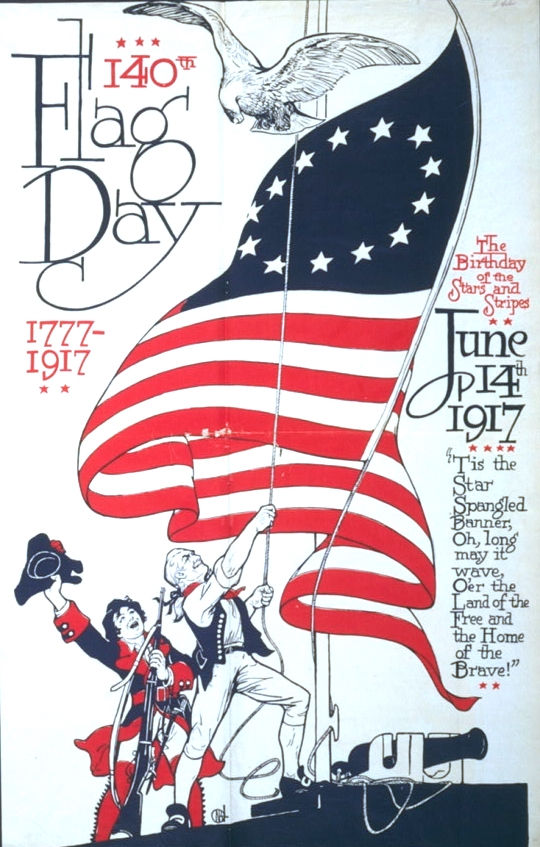
For more on Flag Day and Flag etiqutte, click the poster commemorating the 140th Flag Day on June 14, 1917.